The Dilbert® Life Series: Enterprise Architecture Revisited One Year Later

The Dilbert® Life series is a string of post on corporate culture from hell and dysfunctional organizations running wild. This can be quite shocking and sobering. The amount of damage that can be done by "merely" taking solid technology, methodologies, people and organizations, which you then abuse the hell out of, is amazing. A sense of humor will help when reading this. If you need to live in a sugar coated world were all is well and bliss and think all you do is close to godliness, stop reading right now and forget about the blog entries. It’s going to be dark. Pitch black at times actually, with a twist of humor, if you can laugh at yourself that is. And no, there is no light to shine on things, not even when you lite it. You see, pointing a beam in to the vast empty darkness of human nature doesn’t make you see anything. You do realize there is an endless, vast and cold emptiness out there. This is not unlike the cerebral content of way to many people I come across by in this crazy twilight zone called “the workplace”. I believe some US colleagues refer to those bio carbon life forms as “sheeple”.

Last year my very first blog post (https://blog.workinghardinit.work/2010/01/16/hello-world/) was about the one and only meeting I ever had with the Enterprise Architecture consultants that came in to help out at place where I do some IT Infrastructure Fu. Now one year, lots of time, money, training and Power Point slide decks after that meeting, the results on the terrain are nowhere to be seen. Sure there were lots of meetings, almost none of which I attended unless they dragged enterprise architecture into an IT related meeting on some other also vague action items like the IT strategy that was never heard of again. They’ve also created some new jobs specifications and lots of lip service and they’ll probably hire some more consultants to help out in 2011. But for now the interaction with and impact of any Enterprise Architecture on their IT infrastructure is nowhere to be found.

We put a good infrastructure plan in place for them. It’s pretty solid for 2011, pretty decent for 2012 and more like a road map for the time span 2013-2014. Meaning it’s flexible as in IT the world can change fast, very fast. But none of all this has come to be due to insights, needs, demands or guidance of any enterprise architecture, IT strategy or business plan.  No, it’s past experience and gut feeling, knowing the culture of the organization etc.  Creating strategies, building architectures is difficult enough in the best of circumstances. Combine this with fact that there is a bunch of higher pay grade roles up for grabs and the politics become very dominant. Higher pay grades baby? What do I need to get one? Skills and expertise in a very critical business area of cause!  Marketing yourself as a trusted business advisor, taught leader and architect becomes extremely important. As you can imagine getting the job done becomes a lot more difficult and not because of technical reasons. My predictions for 2011 are that by the end the year those pay grades will have been assigned. Together with a boatload of freshly minted middle management, who’ll be proud as hell and will need to assert their new found status, they’ll start handing out work to their staff.  Will that extra work materialize into results or only hold them back from making real progress? Well, we’ll need to wait for 2012 to know as 2011 will be about politics.

Basically from the IT infrastructure point of view and experience we have not yet seen an Enterprise Architecture and I don’t think they’ll have one in the next 12 months. Perhaps in 24 to 36 months but by then the game plan in IT infrastructure will be up and running. So realistically, I expect, if it leads anywhere against expectations, the impact of an Enterprise Architecture will be for 2014 and beyond. Which means an entirely new ball game and that will need a revised architecture. The success of the effort will no doubt be that they detected the need to change. This sounds uncomfortable similar to the IT strategy plan they had made. So for now we’ll do for them what’ we’ve always done. We’ll work with one year plans, two to three year roadmaps combined with a vision on how to improve the IT infrastructure. The most important thing is to stay clear of ambition and politics. Too much of that makes for bad technical decisions.

You got to love corporate bull. They don’t lie, no sir, they just sell bull crap. Which is worse, truth or lies don’t even matter, just the personal agendas. Liars at least, by the very fact of lying, acknowledge the value of truth, so much in fact, they’d rather have you not knowing it. Most consultancy firms send out kids that are naïve enough to believe the scripts and don’t even realize they are talking crap. They are told over and over again they are right, the best and they like to believe this so much they really do. It’s a bit like civil servants at the EU. Pay people double their market value, sweet talk their ego’s all day long and they will become prophets for the religion of the day. No, I’m not saying Enterprise Architecture is bull crap. I’m saying that way too many people & companies claiming to do enterprise architecture are turning it into exactly that. IT strategies, architectures that are so empty and void of content that all those binders are thrown in a drawer never to be seen again. A fool with a tool is still but a fool. Agile methodologies or tools don’t make your programmers agile gurus just like owning a race car doesn’t make you a race car pilot. All of this has happened before, and all of this will happen again. Every new, innovative process, methodology or concept falls victim to this. The money grabbing sales crowd gets there paws on it and starts selling it as competitive advantage or even innovation in a bottle to the corporate sheeple & management failures that should know better. They end with less money, loads of wasted time and a shitload of dead trees. As a side node, this whole “* Architect” thing  has runs it’s inflationary course. We need a new professional status currency once more. Take care and keep laughing clip_image001!

DCDIAG.EXE Problem On Windows 2008(R2): VerifyEnterpriseReferences indicates problem “Missing Expected Value” & points to Knowledge Base Article: Q312862

I was preparing to replace some 5 year old DELL PE1850 servers running Active Directory with new DELL R610 servers when the DCDIAG.exe output showed a possible issue with SYSVOL FRS and some missing expected value.

Starting test: VerifyEnterpriseReferences

The following problems were found while verifying various important DN

references.  Note, that  these problems can be reported because of

latency in replication.  So follow up to resolve the following

problems, only if the same problem is reported on all DCs for a given

domain or if  the problem persists after replication has hadreasonable time to replicate changes.

[1] Problem: Missing Expected Value

Base Object: CN=DC1,OU=CITY,OU=Domain Controllers,DC=corp,DC=com

Base Object Description: "DC Account Object"

Value Object Attribute Name: msDFSR-ComputerReferenceBL

Value Object Description: "SYSVOL FRS Member Object"

Recommended Action: See Knowledge Base Article: Q312862

The log points to a knowledge base article at  but that has no relevance here.This is a phantom error when found under following circumstances. It occurs on Windows 2008 or Windows 2008 R2 when you are running in Windows 2008 or Windows 2008 R2 domain functional level. Since Windows 2008 the File Replication Service (FRS) that sysvol uses has been replaced with the  Distributed File Replication service (DFRS) as used by DFS. If you’re not yet running DFRS when you can (which is highly recommend  http://blogs.technet.com/b/askds/archive/2010/04/22/the-case-for-migrating-sysvol-to-dfsr.aspx but not required), you’ll see this error show up when running DCDIAG.exe, so no real issue at all.

There are lots of posts on the internet pointing to various possible issues or causes: http://social.technet.microsoft.com/Forums/en-US/winserverDS/thread/2ce07c3f-9956-4bec-ae46-055f311c5d96/  & http://social.technet.microsoft.com/Forums/en-IE/winserverDS/thread/3062d40a-b73e-42ea-b27a-e817ee29abc1. But before you worry to much I suggest you check that everything that has to do with replication is running well. Is so and you’re running in Windows 2008 or Windows 2008 R2 domain functional level you’ll see this error go way once you complete your migration to DFRS.

So, to recapture, if you have a well maintained & working Active Directory, do not panic when you see some warning or failures in diagnostic test results. Make sure things are indeed fine and if you conclude that you don’t have any lingering problems, do some further research on what the real reason might . This pahnatom error is a fine example of this.

There is an absolute brilliant step by step guide to get the move from FRS to DFRS completed without a problem in a series by the storage team at Microsoft . You can find the first of a 5 part blog series over here http://blogs.technet.com/b/filecab/archive/2008/02/08/sysvol-migration-series-part-1-introduction-to-the-sysvol-migration-process.aspx.

While you are at it. If your still running DFS in Windows 2000 native mode, you might want to upgrade that as well. More on that later Smile

2010 My First Year of Blogging & Using Twitter

Well 2010 is coming to an end. This year to me was special because it was the first year I decided to speak out on some issues,subjects and ideas on line via blogging and twitter. The idea behind both was to share knowledge and ideas, promote interaction, getting or keeping in touch with colleagues and using it as a way to exchange pointers to information or even as a lightweight support tool. That has been a success. A big benefit is that I can refer myself and others to the blog as a documentation system for solutions and musings. I’ve been able to reach out to many knowledgeable professionals and experts and I’ve enjoyed both getting and providing assistance. There is a very helpful and smart bunch of people out there, who contribute a lot to the community some of whom I had the pleasure of meeting at Tech Ed Europe 2010.  Being helpful brings me to a point Aidan Finn http://www.aidanfinn.com/?p=11002  recently touched on in a blog post: people expecting or even demanding all things for free. There is no such thing as a free lunch and what goes around comes around. I had to tell people to document their problems and post them on the forums, that’s what they exist for. Most people do that but some expect a solution to a problem that they describe as “it doesn’t work”.  I hope people got something out of the blogs and out of the twitter interaction in the same way I do form their contributions. One of the main questions I had when posting my first blog was if would be able to produce some content worthwhile posting and keep doing it over a prolonged period of time. That went reasonably well I think. In 2011 I’d like to share some knowledge and ideas via workshops, lunch & learns beyond the normal “internal” public. I’ll see how that goes. Good content, good delivery and useful application of shared knowledge of that isn’t that easy and takes quite and effort. That’s definitely something I appreciate. I wish all my IT colleagues a great end of 2010 and a very prosperous, successful, fun and healthy 2011.

Building A New Lab For 2011 And Beyond

Well with all this (Hyper-V) Clustering, Virtualization, System Center Suite, Exchange 2010 & Lync, SQL Servers, iSCSI demands on my lab network  I really need to refresh my hard ware. It sounds a bit like a paradox but such is life for the people building all this stuff. Yes, they still need some hardware, pretty beefy machines actually, to set it all up, test it, break it, fix it and keep learning. I’ve depleted my 4 years old lab material which in which I can’t put more than 4 GB RAM.  Now that I have finished all my infrastructure projects for 2010 I have time to focus on improving my old setup. Or at least I hope. Things are very busy. Thanks to W2K8R2 SP1 beta I could use Dynamic Memory which helped to keep churning away with these and various Exchange setups but now with Lync coming into the picture I want and need an upgrade.  A couple of SQL Servers in various high availability setups help eat any remaining resources resources . Add to that the fact that I want to do some private cloud testing so there it is. I need hosts with at least an Intel Quad Core  (i7) and at least 16 GB of DDR3 memory. They should have room for extra NIC cards. And I always try to get some speedy disks where it matters.  Now since Windows Server 2008 R2  added support for Second Level Address Translation (SLAT), which Intel calls Extended Page Tables (EPT) and which AMD calls Nested Page Tables (NPT) or Rapid Virtualization Indexing (RVI), we can make use of better graphics cards. Until now none of my processors had SLAT support.  With the Intel i7 (Nehalem) processor I’m good to go. As all machine in my lab are Intel so I’m sticking with them for Hyper-V migrations as that doesn’t work between brands.

So here’s an logical overview of my setup. This is what I already in place with my current hardware but have now drawn with my coveted hardware refreshment Smile Oh, yes the dual 1Gbps switches for iSCSI are new for this setup. I’m adding one so I can play with MPIO in the lab.
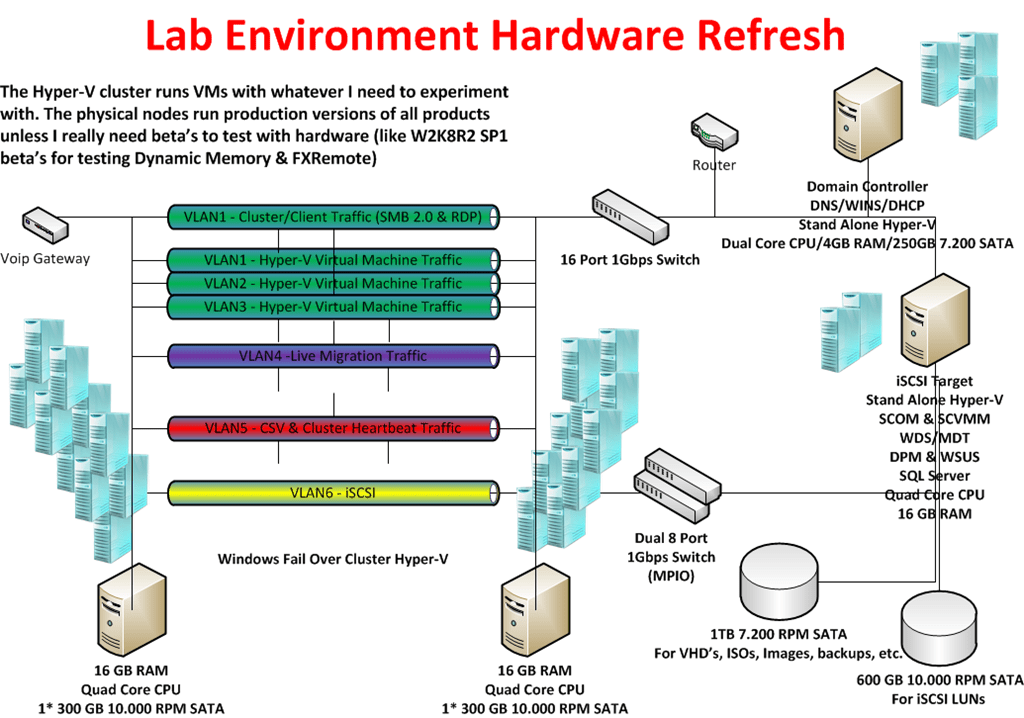
For disks I use 300GB – 16MB – 10.000 rpm and 600GB –32MB – 10.000rpm Raptors in combination with an external eSATA 1TB/2TB Western Digital Black Disk for storage of VHD’s, Images, backups etc.  I have to buy some extra now. The faster disks are expensive but a lab environment needs some performance as waiting around for servers & virtual machines becomes a major of annoyance when you need to get work done. The 10.000 rpm disks are great for iSCSI storage for which I use the iSCSI Target from Windows 2008 R2 Storage server via my TechNet subscription.

All this kit should keep me up and running from 2011 until the end of 2014. Is this expensive? Yes and no.  I can recuperate my 1 Gbps Intel NIC’s and most of my hard disks.  I already have my network switches, monitors and KVM switches. So in all it’s the new motherboards, CPU’s and memory that will eat the  most of the budget.  It’s a sum to put out but here’s a note to all IT Pro’s out there. You need to invest in yourself every now and then.

I’ve blogged about this before in https://blog.workinghardinit.work/2010/02/04/having-a-lab-using-it/. Self improvement and learning is a continuous process that never ends. Sure it does have some peak moments in financial costs when you need equipment. Remember you don’t need to buy it all at once. Talk to you employer about this if you’re not self employed. Look at how much a 5 day advanced course or a conference costs. You can use a lab to learn and experiment for many years to come. So basically the potential ROI is very good. In the end, what my employers and customers get out of this is knowledge, insight, skills and results. Think about it, it helps to put the investment in perspective. Sure, I invest more than just the hardware, my time which is very valuable to me. You can’t maker more time, everyone has the same 24 hours in a day. Now it really helps if you like this stuff and have fun whilst learning new technologies or setting up a proof of concept. In a way what people put into their job and knowledge is  an indicator of their professionalism. You do not become an expert by working 9 to 5 and only learning when a course is provided. It’s not going to happen. Even a genius who puts in the effort stands out amongst his or her peers. The same goes for you, but be smart about it. You can work yourself to death and not accomplish anything. So smart & hard is the way to go.