Attending the Dell Tech Summit EMEA

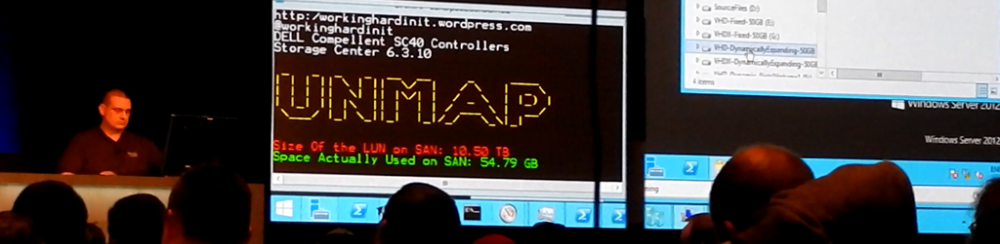
As you read this I’m preparing to get on my way to the DELL Tech Summit in Lisbon, Portugal for a few days. I’ll be discussing the needs we have from them as customers (and their competition actually for that matter) when it comes to hardware in the Microsoft landscape in the era of Windows Server 2012.

image

I’m very happy and eager to tell them what, in my humble opinion, they are doing wrong and what they are doing right and even what they are not doing at all Smile  I believe in giving feedback and interaction with vendors. Not that I have any illusion of self importance as to the impact of my voice on the grand scheme of things but if I don’t speak up nothing changes either. As Intel and Microsoft are there as well,  this makes for a good selection of the partners involved. So here I go:

  1. More information on storage features, specifications and roadmaps
  2. Faster information on storage features, specifications and roadmaps
    • Some of these are in regards to Windows Server 2012 & System Center 2012 (Storage Pools & Spaces, SMI-S, ODX, UNMAP, RDMA/SMB3.0 …) and some are more generic like easier & better SAN/Cluster failovers capabilities, ease of use, number of SCSI 3 persistent reservations, etc.
  3. How to address the IOPS lag in the technology evolution. Their views versus my ideas on how to tackle them until we get better solutions.
  4. Plans, if any, for Cluster In a Box (CiB) building blocks for Windows Server 2012 Private Cloud solutions.
  5. When does convergence make sense and when not cost/benefit wise (and at what level). I’d like a bit more insight into what DELLs vision is and how they’ll execute that. What will new storage options mean to that converged network, i.e. SMB 3.0, Multichannel & RDMA capable NICs. Now convergence always seems tied to one tech/protocol (VOIP in the past, FCoE at the moment) and it shouldn’t, plenty of other needs for loads of bandwidth (Live migration, Storage Live Migration, Shared Nothing Live Migration, CSV redirected mode, …).

Now while it’s important to listen to you customers, this is not easy if you want to do it right, far from it. For one we’re all over the place as a group. This is always the case unless you cater to a specialized niche market. But DELL serves both consumers and enterprises form 1 person shops to fortune 500 companies in all fields of human endeavor. That makes for nice cocktail of views and opinions I suspect.

Even more importantly than listening is processing what you hear from your customers. Do you ignore, react, or take it away as more or less valuable information. Information on which to act or not, to use in decision making, and perhaps even in executing those decisions. And let’s face it without execution decisions are pretty academic exercises. In the end management is in control and for all the feedback, advise, research that gathered and done, they are at the steering wheel and they are responsible for the results.

One thing that I do know from my fellow MVPs and the community is that for the past 12 months any vendor who would address those questions with a good plan and communications would be a top favorite while selecting hardware at many customers for a lot of projects.

Intel X520 Series NIC on Windows 2012 With Hyper-V Enabled Port Flapping Issue

When you install Windows Server 2012 RTM to a server with X520 series NIC cards you’ll notice that there is a native driver available and the performance of that driver is fantastic. It’s really impressive to see.

image

That’s great news but I’ve noticed an issue in RTM that I already dealt with in the release candidate.

The moment you install Hyper- V some of the X520 NIC ports can start flapping (connected/disconnected).  You’ll see the sequence below endlessly on one port, sometimes more.

image

image

image

As you can imagine this ruins the party in Hyper-V networking an bit too much for comfort Confused smile But it can be fixed. The root cause for this I do not know but it is driver related. The same thing happened in the release candidate. But now things are easier to fix. Navigate to the Intel Site to download their freshly released driver for the X520 series on Windows Server 2012 and install it (you don’t need to install the extra software with Advanced Network Services => native Windows NIC teaming has arrived). After that the flapping will be gone.

image

Hope this helps some folks out!

Hyper-V Shared Nothing Live Migration In Windows Server 2012– VM Mobility Rules

I see and hear some people shrug at the idea of Shared Nothing Live Migration, dismissing it as marginally useful. Some do state they’ll have it as well but that it’s not that valuable. Well I disagree totally. A lot of the time these remarks are due to a lack of understanding about how several technologies in the Microsoft stack work together. Combine this with tunnel vision and the fear of some vendors and you get a lot of FUD.

I advise you to look beyond the virtualization stack, to the issues that people who are building infrastructure for dynamic, flexible and * cloud  data centers are dealing with.

Look, as “architects” we have to design & build for failure. We all know that it’s just a matter of time before things go BOINK.  So we build in redundancy, some of this within a silo, some of this is between silos. The two approaches compliment each other. What this gives you is options and everybody who knows me, especially those who work  with me has heard my mantras: “Assumptions are the mother of all F* Ups” and “Options, options, options”. Make sure you design & build in options. This way you can maneuver your self out of a bad situation. Don’t ever assume you’re out of options, especially not when you put some in the design on purpose Winking smile. It’s also very useful beyond that because a lot of you might agree with me that silos and fork lift, down time inducing upgrades, migrations, transitions or replacements are expensive and bad. This is where Share Nothing Live Migrations comes into play. You gain mobility over silos. That silo might be a server, a cluster, storage or mixtures of them all.

With Shared Nothing Live Migration we can migrate virtual machines between those silos with nothing more than a network cable.This is huge people. You are no longer trapped in that silo. In this context it provides you with all the options & flexibility mobility gives you. even it the technology itself is not about high availability.

Some very useful scenarios

Migrate virtual machines from an old cluster to a new cluster with out any down time

  1. Migrate virtual machines from stand alone hyper-V hosts to a fail over cluster with out any down time
  2. Migrate virtual machines from one stand alone host to another one for maintenance, again, without any down time
  3. Choose different types if storage & Hyper-V deployment depending in IOPS, redundancy, availability, manageability needs. With Shared Nothing Live Migration you can be confident  that  you can move your virtual machine from one environment to the other when needs change. This is breaking the storage silo boundaries open people! This is huge … think about it.

How it works

The details are for another post but basically is made possible by the combination of Live Storage Migration and Live Migration.

First the Storage is Live Migrated

image

After the Live Storage Migration is done the state of the virtual machines is copied and synchronized.

image

This Is Mobility

I hear the competition shrug.  It isn’t high availability. Well indeed no one who understands the feature ever said it was. It’s virtual machine mobility. Look at the scenarios above and you’ll see that this ability could very well be game changer in how we look at storage & design solutions.

Speed & Performance

What did we hear on this front: “it will be too slow to be really useful”. Really? Well let’s see:

  1. The world is converging to 10Gbps and after that 40Gbps and up will come
  2. NIC Teaming in box With Windows 2012 which can provide more bandwidth.
  3. SMB 3.0 Multichannel. This provides multiple channels per connection spreading the load over multiple CPUs
  4. SMB Direct, have you seen the speeds this achieves?

Before you state that this doesn’t work on Live Migration … as confirmed at TechEd 2012 Europe with Jose Baretto this does work when both the source AND the target is an SMB 3.0 share. This means yet another reason to use SMB 3.0 share for your Hyper-V storage needs! So unlike what Tad at vLimited keeps saying, unhindered by any knowledge, it is a very valuable feature and it can be extremely fast given the right connectivity and storage that can handle the IOPS. And no, the fact that it’s unbuffered doesn’t impact this to much. Test this by using xcopy/robocopy /J with a VHD over your infrastructure.

image

Even if you’re on a budget and cannot go for the RDMA NICs & SMB 3.0 you have several options to get very decent virtual machine mobility and not be stuck in a silo. And for those who want to leverage this feature to create and agile & mobile virtual environment you have some very nice technologies available to optimize to your needs & budgets.

Conclusion

Virtual Machine mobility and storage mobility are very interesting features that provide for a previously unknown flexibility. Windows Server 2012 makes us rethink our storage approaches (I sure am) and I’m very interested in seeing how this will evolve.

Windows Server 2012 Hyper-V Supports IPsec Task Offloading

IPsec has been around for a while now. In an ever more security conscious & regulated world you want and/or are required to protect your network communication by
authenticating and encrypting the contents of at least some of your network traffic. Think about SOX and HIPPA and you’ll see that trade or government security requirements are not going anywhere but up for us all. This is not just restricted to military of intelligence organizations.

We’ve seen the ability to offload IPsec traffic to the NIC for a while now. This is great as the IPsec processing is a very CPU intensive workload. Unfortunately it didn’t work for virtual machines . Until now IPsec offloads was only available to host/parent workloads in using Windows Server 2008 R2. The virtualization of high volume network traffic workloads that require encryption means a serious hit on the resources on the host. If you’re willing to pay you might get by by throwing extra host & CPU power at the issue. But what if the load means a single virtual machine with 4 vCPUs can’t hack it? Game over. Sure Windows Server 2012 Hyper-V allows for 32 vCPUs now,  but that is very costly, so this is not a very cost effective solution. So in some cases this lead to those workloads being marked as “unsuited for virtualization”.

But with Windows Server 2012 Hyper-V we get a very welcome improvement, that is the fact that a virtual machine can now also offload the IPsec processing to the physical NIC on the host. That frees up a lot of CPU cycles to perform more application-level work, resulting in better virtualization densities, which means less costs etc.

Let’s take a look where you can set this in the Hyper-V GUI where you’ll find it under the network adaptor /Hardware Acceleration.

image

IPsec offload is also managed by the Hyper-V switch, this controls whether the offloading will be active or not. This is to prevent that the IPsec offload stopping the services if insufficient resources are available. Please do note that IPsec when required in the guest will be done anyway creating an extra CPU burden. So this does not disable IPsec, just the offloading of it. On top of this and in the gravest extreme you can guarantee that IPsec servers can get the resources they need by sacrificing less important guest if needed. by using virtual machine prioritization. The fact that you can configure the number of security associations helps balancing the needs of multiple virtual machines requiring IPsec offload.

To conclude, this wouldn’t be Windows Server 2012 if you couldn’t do all this with PowerShell. Take a look at  Set-VMNetworkAdapter and notice the following parameter:

-IPsecOffloadMaximumSecurityAssociation<UInt32>

This specifies the maximum number of security associations that can be offloaded to the physical network adapter that is bound to the virtual switch and that supports IPSec Task Offload. The thing to notice here is that specify a zero value is used to disable the IPsec Offload feature.

image