The Issue
One of the biggest showstoppers people come across when virtualizing servers is often software license dongles. A lot of software vendors have decided that such measures are needed to protect ‘m from piracy. I don’t think it works. I might prevent the occasional unlicensed use but it has never stopped a determined “pirate” from cracking & hacking the dongles or the software and offering that solutions on the dark side of the internet. The only cookies they have are poisonous 😉
But short of all the stupid issues paying customers will have with license dongles, when it’s time to virtualize the servers you’re in trouble. There is no USB device on a virtual machine to stick that dongle into. Some quality desktop virtualization solutions like VMware workstation do offer USB support but the heavy duty server production hypervisors do not. So now there is an extra issue to solve. The solution to that problem can be solved USB over Ethernet software. When we start talking about physical COM port mapping (SMS Gateways anyone and other “esoteric” engineering toys …) it’s the same issue. But what’s discussed below is also valid for that problem. The companies have software for that as well.
The Solution
When you need to virtualize server applications that need a locally attached dongle you need to start looking for USB over Ethernet solutions that are reliable, support x64 bit, have signed drivers and support your Operating Systems. Normally you pay for the number of servers and USB device connections for which you get a license key. The client software is free and unlimited.
I’ve used both Fabulatech and KernelPro. But now I exclusively use KernelPro. FabulaTech version 4.1.1 was rock solid but ever since version 4.2/4.3 & 4.4 Beta they have brought us nothing but “Blue Screen of Death” hell either simply in production or during reboots (server grade hardware, DELL, HP). They really dropped the ball in a huge way It also had issues with clean uninstalls for upgrades etc. We just had to cut our losses after many months of frustration and troubleshooting as we were bleeding money and losing valued customers, not to mention our reputation. We now implement KernelPro USB over Ethernet version 2.5.5 as the solution of our choice. It works very well and we just never had an issue with that product. In the Hyper-V guest you install the client software and make sure to allow the needed ports in the client firewall configuration. For a license dongle you still need the dongle drivers to be installed but once that done you’re golden. To make sure server reboots do not interfere with the licensing I configure the USB over Ethernet software to automatically connect the correct USB device to the correct client. To prevent unwanted client connections you can use a IP filter list to allow or disallow client connections and disable USB devices for sharing. When using DNS names be aware of DNS Client Caching etc. when you change the IP address of a client and such. During fail over testing that might trip you over. I your application supports multiple dongles you can even create fault tolerant USB over Ethernet setups. Now try to sell that to a client: “Hello, I’m the architect of you highly available USB over Ethernet License Dongle solution for your Hyper-V farm”. Been there, done that!
Due Diligence
As I’ve written in a previous blog post “Perversions of IT: License Dongles” (https://blog.workinghardinit.work/2010/03/29/perversions-of-it-license-dongles ) you need to be aware of the fact that you need to manage the Ethernet over USB environment very carefully. Make sure the versions of the server software and the client software are the same on all nodes. We’ve seen network connectivity loss when the versions don’t match up, even if the software didn’t complain about different versions. Always make sure they are running the same version. Don’t just randomly update. For this reason I always disable the check for updates.
You need to test its stability, have some extra hardware and extra dongles for testing as to confirm your dongles respond well to this type of setup. We can’t afford to bring down production environments with USB over Ethernet software “upgrades of faith”. With some clients the license dongles become a virtualization show stoppers due to such risks. Talking about technology debt a cheap piece of plastic license protection is preventing paying customers from virtualizing. How do you think they feel about you as a software company. You’ll find out when they find an alternative without a dongle 😉
RemoteFX USB Support to the rescue?
When Windows 2008 R2 SP1 was announced there was also a lot of talk about support for USB devices via RemoteFX USB . I was very happy with that because it’s a very useful and handy feature. Initially I was also optimistic about the fact that it might help with the license dongle issue. But as the name says, it very much geared to offer support for VDI environments. That means you’ll be able to hook up cameras, license dongles for interactive user apps so you can run them on your virtual desktop, USB rocket launchers (http://www.youtube.com/watch?v=EmZ-QKglyrc ) and the works.
Now for server applications there is no option provided for mapping the USB dongle on a parent partition to a child partition permanently. So basically for such needs , and in my neck of the woods I have a bunch of those, there is no built in solution. Software running as a service, License software running a couple of dongles and offering network licenses for applications will still need a USB over Ethernet solution. One little positive thing is that I heard rumors that one software vendor is dropping the need for a dongle. On small step but we’ll call that progress anyway. I hope the virtualization push forces a lot of others to do likewise and forget about license dongles. Typically for such companies that will be very late in the game. By the time they acknowledge the needs and realties in the field most customers have dumped that vendor or work around the problem on their own time and at their cost. So a vendor solution is always late. When they have it the industry progress has already led to another problem with their software due to bad choices they made in the past. Such is life. Still I have one advice for software companies: become good or get out!

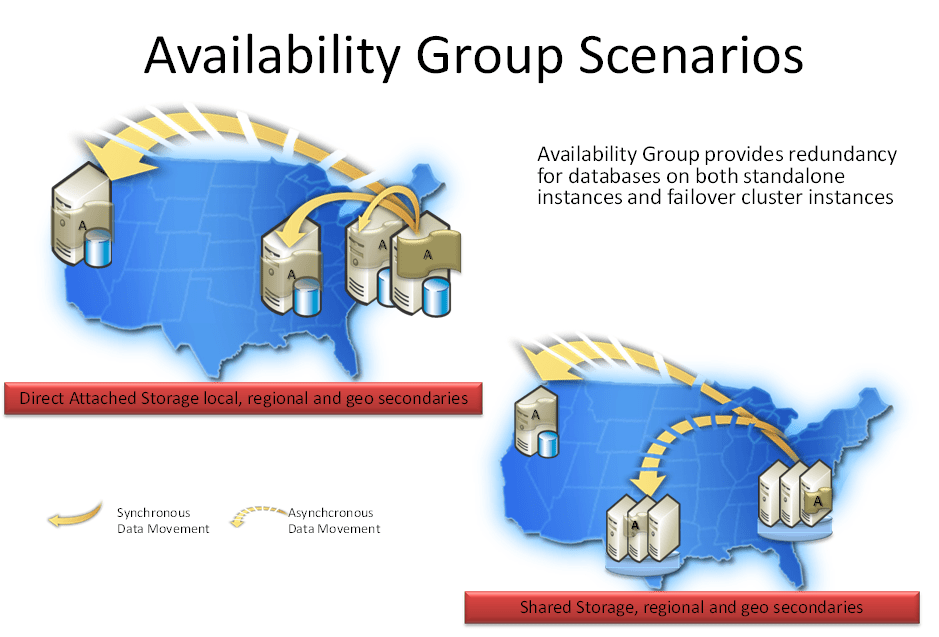 Availability Group can provide redundancy for databases on both standalone instances and failover cluster instances using Direct Attached storage (DAS), Network Attached Storage (NAS) and Storage Area Networks (SAN) which is useful for physical servers in a high availability cluster and virtualization. The latter is significant as they will support it with Hyper-V Live Migration where as Exchange 2010 Database Availability Groups do not. I confirmed this with a Microsoft PM at Tech Ed Europe 2010. Download the CTP here and play all you want. Please pay attention to the fact that in CTP 1 a lot of stuff isn’t quite ready for show time. Take a look at the Tech Europe 2010 Session on the high availability features here. You can also download the video and the PowerPoint presentation via that link. At first I thought MS might be going the same way with SQL as they did with Exchange, less choice in high availability but easier and covering all needs but than I don’t think they can. SQL Server Applications are beyond the realm of control of Redmond. They do control Outlook & OWA. So I think the SQL Server Team needs to provide backward compatibility and functionality way more than the Exchange team has. Brent Ozar (Twitter: @BrentO) did a Blog on “Denali”/Hadron which you can read here http://www.brentozar.com/archive/2010/11/sql-server-denali-database-mirroring-rocks/. What he says about clustering is true. I’ use to cluster Windows 2000/2003 and suffered some kind of mental trauma. That was completely cured with Windows 2008 (R2) and I’m now clustering with Hyper-V, Exchange 2010, File Servers, etc. with a big smile on my face. I just love it!