I got quite a few requests to share some mind musing on trends and deliver some predictions for 2015. You’d think Warren Buffet would make more sense as the person to ask but what do I know.
Luckily Andreas offered me his second hand palantir for sale …

So now, together with my splendid sense of humor we have what we need for a blog post so here we go:
The big 4 resources & cloud
Memory
Ever more (and bit faster) at a steady but slow pace but with latency dips as a bummer. As long as the other resources don’t push it forward this will continue. And this is starting to happen. They need to kick into action with more capacity and way higher speeds, lower latencies and less power consumption or they’ll become the bottle neck in a few years time. So that’s a an easy roadmap for the industry, so make it happen and don’t bother me with those pesky technical details (sorry, management training kicked in).
Networking
TCP/IP & Ethernet … the old breed … well they’re going strong and brave. 10Gbps, 40Gbps, 100Gbps … Look, generally speaking, if you renew you data center networking today (as you think public cloud can’t handle it all yet) and 10Gbps is not a major or even the default player I don’t know what to tell you anymore. Love what Mellanox has done so far. Some issues with the quality of other vendors worry me some times.
FC … it will be around. Just a even less dominant. FCoE? I see very little of it in the wild. iSCSI yes, even lossless iSCSI (DCB). NFS is doing well, SMB3 keeps growing (and people will make some mistakes learning the technology). Infiniband? Well the low cost is a major benefit still and if they could have 300 or 500Gbps in place before Ethernet get’s there … it will be around in the future.
Oh and iWarp wise Chelsio needs competitors that rock and drive down prices or I’ll keep doing RoCE where ever I can, even if it’s harder (DCB configs remain a learning curve).
IPv6 will keep growing … but not as fast at it should unless something really weird happens in enterprises.
Compute
Intel will remain dominant for some years but the landscape is changing. Bar some innovative attempts under way the fight for the PC/Server CPU is not raging anymore. Intent is nice for the prosecution or defense at a trial, not for success in the market place. 2015 is not going to be major shift in compute but it’s an interesting space to watch.
Storage
Prices will drop more and more and that will mean the SAN in combination with flash will fight on a bit longer. Some hyper converged solutions need better and easier manageability to prove them selves worthy. Also I’d love to see flash only storage, for IOPS/latency but also for power/cooling. Give me 6TB SSD for archival & backups, & fast 1TB disks for that can handle huge amounts of read/write for speed. When they get to a price point where this becomes feasible I’ll be the first in line. Basically breaking the price barrier is key here and it matters a whole more to me that the SAN/Web Scale/Hyper Converged discussion. If the new players can start addressing their weakness (i.e. stop bashing SANs for their weaknesses but learn from their strengths) they’ll move faster to a better market position. Data protection, replication, centralized ease of management etc. It took the classical SAN storage world 15 years to get to good general solutions (not great ones) and I think the web scale (I don’t like that name), hyper converged will need some time to get their act together in those areas. They tend to focus a lot on their strengths but they have some very annoying operational weak spots in my humble opinion. I hate data silos. I want data to be able to move & flow to where I want it. Mobility is key. Either storage delivers this or the hypervisor will.
The good news is storage vendors are under pressure to deliver ever more value / $ and that’s a good thing for us customers.
Software Defined Anything
Work in progress. It’s a journey. Most software defined pundits will have to deal with the fact that reliable and predictable hardware is not to be taken for granted when you dive into layering offloads on top or with each other and into ever more layers of abstraction and functionality. Humble pie: hardware vendors delivering quality seem to do more that just wield a soldering iron 
Cloud
- Public Cloud => for the win!
- Hybrid cloud => depends on you definitions & business but it’s strong and can be very useful when done well for the right reasons.
- Private Cloud => think very carefully if you have the scale, need and if it makes sense and really delivers value.
The Vendors
IBM will slowly but surely dump all hardware(bar some golden chicken varieties) and focus on expensive services, business consulting, overpriced refurbished job site pick up “consultant” pimping & the newer markets of the IoT. I get that, no use in trying to win the previous war.
HP will cost cut itself into oblivion a bit more in 2015. Only interesting piece of kit they have right now is moonshot and, forgive me, I don’t think it will be that hard for anyone to make a similar solution that’s better. Look at what CISCO UCS did to the server business. I do wonder in what manner the split my give us a surprise or will it be a non event?
Dell needs more visibility. I hope that while they are off many people’s radar screens they’re hard at work to surprise us in the next years. If they can remain profitable they might just become the gold standard of OEM hardware as the others have left or failed & the low end is picked up by the budget players. They do need to watch those.
Oracle? Oracle has been dead to me a decade ago. Unless you have their RDBMS & 3rd party solutions on top that are over priced & underwhelm (SAP, …) in place and your stuck throwing money at them. You should have learned a lesson from IBM mainframe customers but you didn’t.
Google. Profitable as can be I guess. I love their search mojo but I do not trust any of their offerings. I only use it for low value and throw away use cases. They’re not trustworthy enough for me.
Apple. Overpriced, under delivering hardware. A tax on stupid people with a magnificent glossy wrapper. But they have a truckload of cash and they might wake up and pull the IoT thingy with IBM off in the enterprise.
Amazon. Top notch cloud shop and that’s the problem. Can they sustain the war of attrition with Microsoft or Google? I’m afraid they won’t be able to.
On the whole 2015 will be another step in ever less vendors taking ever more pieces of the cake. Bad for competition, innovation & the customer in the end. The IT world is looking more and more like the energy market. Nobody but the money men like ‘m, but we can’t live without them. Just like telcos.
“They barely make a profit” you say? If so they’re either incompetent or they are so in love with hoarding ever more money that they confuse that with their main business, supplying a commodity service. So let’s hope the cloud doesn’t end up there, but I’m not betting on it.
Just like with telcos the barrier to entry is too big for meaning full competition, bar some superb initiatives like

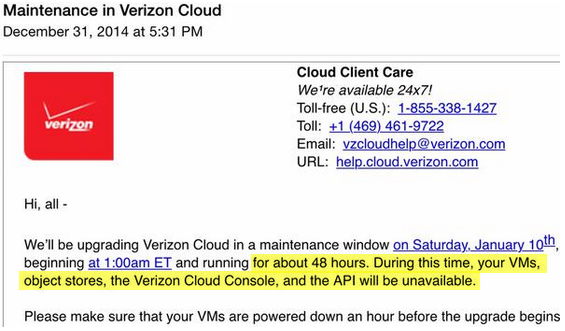
Even a large telco cannot compete in cloud offerings on a serious level. Look at this gem to proof this.
Microsoft. Well there in an ever lasting fight for survival today and for their future as all companies are. Nadella is wicked smart and seems to have a positive effect and a clue. Let’s hope that continues. With some smarter licensing and some honey they could grab more of the competitors market and make up for it in volumes, but if they don’t have to they won’t, after all they’re in business to make money.
Businesses & Organizations
What will most organizations do in 2015? Some will thrive, a lot will be stagnant and try to maintain status quo or at least keep up appearances. Some will dig deeper and deeper down the hole they’re already in.
The good
Switched on companies figured out long ago it not of matter of what to use. It’s where and why. You can use everything available on the marketed form commodity to custom designed as long as you use it where it makes a difference. Use what you need for the job at hand. Not all jobs and situations require the same tools or methods. That’s why the arsenal of known (commodity) and secret (innovative) tools is so diverse & big. The “secret” sauce is having a clue. Those are the business where you can work, have fun, learn and grow.
The bad
A lot don’t have a clue. So lacking the secret sauce they buy what’s on the shelf labeled “great & proven track record”. Meaning they’ll cut costs more than anything else. This one is very popular. It’s easy and measurable. Especially if you don’t look at the holistic result and are very careful to only measure what constitutes savings and smooth talk runaway costs as a more mature, complete & professional solution where under deliverance is a “growing pain’.
The ugly
We’ll see people copy game books from the last wars & hope to build for the future while destroying it. Inertia will do it’s corrosive work, destroying capital, time & motivation driving them into a downward spiral of ever more costs for ever less return as the usual suspects blame culture & disengaged employees.
Some will even manage to show up with a dreadnought in a modern conflict because literature states that outgunning the opponents battle ships is key in winning battles. Never mind it’s an air battle, as long as it ITIL compliant, there’s a service catalog & CMDB. It all reminds me of children playing “war”. Whilst I realize that keeping you inner child alive is important, this is not what they mean by that.
Final note
I think this blog post just graduated me as a IT journalist of some kid 

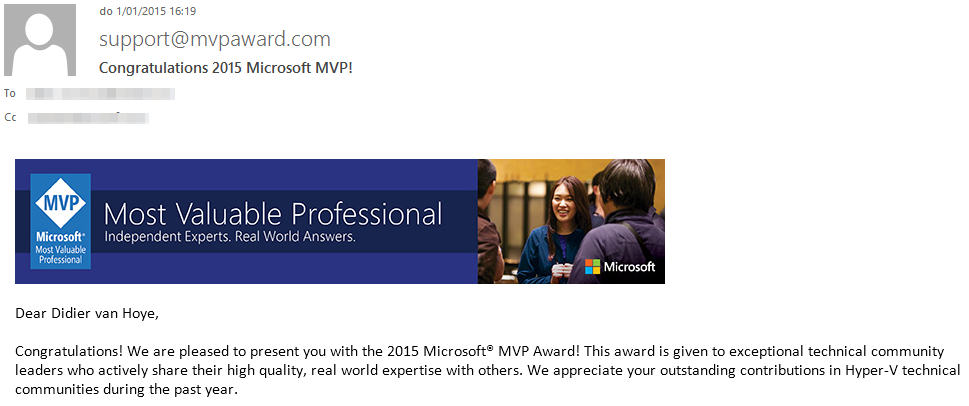
 . They don’t need an "echo chamber" they value opinions, insights and experiences. The MVP award is for the things you’ve done and do. Sure, there is a code of conduct but that doesn’t mean you cannot voice your concerns. "Independent" means that what we say doesn’t have to be sugar coated marketing. Our value is in the fact that we help out the community (their customers, partners and Microsoft itself) in the better use and development of their solutions base on our real world experiences. Microsoft discusses that