Key Take Aways From MMS2013

Introduction

I’ve parked myself at McCarran International Airport in Las Vegas awaiting the start of my long haul home to Europe. The new terminal is inspiring me to share as I reflect on the past week and on what’s happening at work.

ICT in the 21st Century

A lot is going on and moving in ICT and even more is coming our way. In the Microsoft sphere we got the official heads up at MMS2013 that new features would be publicly discussed at TechEd 2013 (USA or Europe). So you might want to attend that one. I for one think that’s great. We need that information to verify we’re still are on the right track and fine tune our course. Especially in those areas where we can get quick wins with sometimes significant cost savings & benefits.  I could start telling you about all the great sessions and products at MMS2013 whilst quacking like a duck “cloud, cloud, …, cloud, cloud, cloud, … cloud”. But I will not. You can watch it all here.  I will reflect on the key take away.

Cheaper & Faster

Cheaper AND faster are the new mantra or’ “fast is the new cheap”. Cheaper makes everyone happy especially when quality remains high. Faster is sometimes a bit more of a challenge to sell. “New features, already?”  you say. Yes. The nature of our economies and industry is being transformed by the cloud and commoditization. It brings a lot of benefits, especially in a high speed, low drag world.

Fast is actually faster. For many years now any strategy & execution plan that took more than a couple of years was doomed. You get bypassed and your big investments will never live up to their potential. So, apart from the necessary larger and more long term investments, we evolve more and more towards a perpetual improvements & rapid adoption model. Innovation and the subsequent commoditization of it is pushing this. That’s not bad. By making constant smaller (easier to fund) investments that deliver fast results we get to a more adaptable, agile environment for lesser costs. It’s not that all long term, large scale projects are going away but the ratio is shifting. In smart countries this is already being done for building hospitals and other infrastructure that evolves fast. It’s not unique to ICT. Massive projects taking too long and too much funding lead to out of date solutions at the time of delivery at huge costs. Use this approach where needed but forget about it for the other projects. Cloud will be an important tool in all this, not the goal.

A Word of Warning

Fast and cheap shouldn’t translate into mediocre crap at dump pricing that will bite us. It should also keep in mind the ecosystem and don’t act like a shock & awe offensive leaving everything in it’s track in disarray. It needs to fit into a plan with clear goals an knowing where it fits in and helps.  It’s about balance. That’s the art. Knowing what, where, when and with/for who to do it. Not easy. Now let’s hope some of my managers read this blog. It might help them. As the question beckons an answer: who is it that will lead us in this new era? Well not one single person, far from it. It’s a team effort and to lead a team takes competence and some character.

It takes competence and personality

Competence and personality, combined with  applying both these (skills and  drive) diligently in a sustained fashion. That requires a lot of effort, even when no one is watching you, or perhaps better stated, especially then. Do what needs to be done where and when needed. Not because it could get you promoted or more money. That’s the character part. That’s what drives us to learn by participating in our ICT communities, presenting, attending conferences and networking. But also in those hours spend reading, studying and working in the lab alone or with a buddy. That’s what will make us able to handle the though and bad situations you’ll encounter and overcome them. It’s your resourcefulness that will make you seek and find opportunity in adverse conditions. People like the team members amongst whom I have the distinct pleasure of working. You can’t find such synergy if it’s only about personal gain and getting ahead. There is both a broad and deep skill set needed by all involved and doesn’t come easy nor can it be bought. It has to be acquired through work and experience. The transformation of the ICT landscape is uncharted domain for all but a few of us so it’s going to ask a lot of effort, often outside of our comfort zone.

Sure there are cynics who laugh at this and can’t imagine why someone would do all that without personal and immediate reward. Those are the ones we don’t need and who won’t be there at crunch time. Only after the facts they seek the spotlight to poach the glory if things went well or to condemn those that failed whilst trying. Well, the last so called leader who did that doesn’t work with us anymore. Enough said.

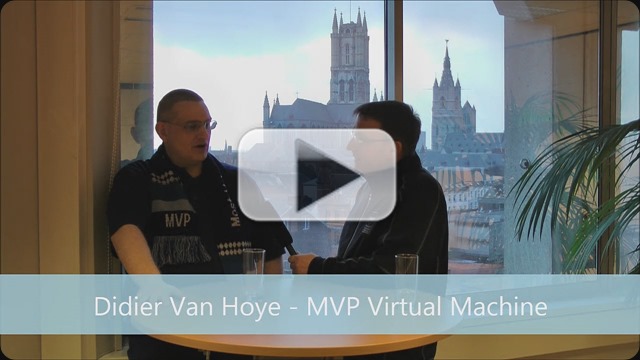
Interviewed by Kerstin Rachfahl on what it’s like to be an MVP

At the end of the 2013 MVP Global Summit I was interviewed by Kerstin Rachfahl @ItsmeKerstin on what it’s like to be an MVP. You can find the results of her diligent & rendering work here or click on the picture for the link.

image

If you notice that I mention meeting, learning from and interacting with a large number of intelligent and passionate people a couple of times as one of the best thing about being a MVP than that is because it just is Open-mouthed smile

MMS2013: SD-B303 How to Build Your Strategy For a Private Cloud

Eduardo Kassner delivered a great session. You can look at it here when it becomes available. Give it 24 hours after real time delivery.

What’s more, he was deadly honest about the realities in the field. Only 2% of customers are effectively using a private cloud … He also offered some very simple tool for getting started with projects to get things done and deliver results. All you need is a Hotmail account and an internet connection to use the tool. It produces reports and MS Project files for the needed projects, Visio diagrams etc. The Optimization Assessment Tool generates reports that can serve as the baseline for planning an effective roadmap and as an incentive for optimizing your IT infrastructure. The detailed Roadmap plan will be generated as part of the Discovery tools.

Now we can be skeptical and realistic that this tool is not perfect. But that same reality is that I have seen a lot less results from expensive consulting and “non committed” attempts at doing something with cloud. The two Dilbert cartoons below demonstrate this very adequately while at times being a bit to close to reality for comfort.

January 07, 2011

November 18, 2009

Windows Hyper-V Server 2012 Live Migration DOES support pass-through disks–KB2834898 is Wrong

See update in yellow in line (April 11th 2013)

I recently saw KB2834898 (pulled) appear and it’s an important one. This fast publish statement is important as until recently it was accepted that Live Migration with pass through disks was supported with Windows Server 2012 Hyper-V Live Migration (just like with Windows Server 2008 R2 Hyper-V) as long as the live migration is managed by the Hyper-V cluster, i.e. the pass through disk is a clustered resource => see http://social.technet.microsoft.com/wiki/contents/articles/440.hyper-v-how-to-add-a-pass-through-disk-on-a-failover-cluster.aspx

UPDATE April 11th 2013: Now after consulting some very knowledgeable people at Microsoft (like Jeff Woolsey and Ben Armstrong) this KB article is not factual correct and leaves much to be desired. It’s wrong, as pass-through disks are still supported  with Live Migration in Windows Server 2012 Hyper-V, when managed by the cluster, just like before in Windows 2008 R2. The KB article has been pulled meanwhile.

Mind you that Shared Nothing Live Migration with pass through disks have never been supported as there is no way to move the pass through disk between hosts. Storage Live Migration is not really relevant in this scenario either, there are no VHDX file to copy apart fro the OS VHDX. Live migrations between stand alone host are equally irrelevant. Hence it’s a Hyper-V Cluster game only for pass through disks.

I have never been a fan of pass through disks and we have never used them in production. Not in the Windows Server 2008 R2 era let alone in the Windows Server 2012 time frame. No really we never used them, not even in our SQL Server virtualization efforts as we just don’t like the loss of flexibility of VHDX files and due to the fact that they tend to complicate things (i.e. things fail like live migration).

I advise people to strongly reconsider if they think they need them and only to use them if they are really sure they actually do have a valid use case. I know some people had various reasons to use them in the past but I have always found them to be a bit of over engineering. One of the better reasons might have been that you needed disks larger then 2TB but than I would advise iSCSI and now with Windows Server 2012 also virtual Fibre Channel (vFC), which is however not needed due to VHDX now supporting up to 64TB in size. Both these options support Live Migration and are useful for in guest clustering, but not as much for size or performance issues in Windows Server 2012 Hyper-V. On the performance side of things we might have eaten a small IO hit before in lieu of the nice benefits of using VHDs. But even a MSFT health check of our Virtualized SQL Server environment didn’t show any performance issues, Sure your needs may be different from ours but the performance argument with Windows Server 2012 and VHDX can be laid to rest. I refer you to my blog Hyper-V Guest Storage Performance: Above & Beyond 1 Million IOPS for more information of VHDX performance improvements and to Windows Server 2012 with Hyper-V & The New VHDX Format Leads The Way for VHDX capabilities in general (size, unmap, …).

Is see only one valid reason why you might have to use them today. You have  > 2TB disks in the VM and your backup vendor doesn’t support the VHDX format. Still a reality today unfortunately Annoyed But that can be fixed by changing to another one Winking smile