KB2616676 Patching Hiccup Discovered by Out of Sync Cluster Nodes

I was investigating an issue on a Windows 2008 R2 SP1 cluster and as part of my check list I ran the cluster validation. Than came out clean but for the fact that it complained about an update that was missing on some of the nodes.

That update was Microsoft Security Advisory: Fraudulent digital certificates could allow spoofing or KB2607712 Not that these cluster nodes are web clients but this is not good and we need to have this fixed for both security & cluster supportability reasons.

But neither WSUS or Windows Update indicate that there is an update available for these nodes. So I download the patch manually and try to install it. Then I get the response: ‘This update is not applicable to your computer’

No good! Now we need to find out what’s up. After some searching we find other people with this issue in the Microsoft forums: KB2607712 does not download to clients.

As it turns out KB2607712 was erroneously marked as superseded by KB2616676. This means that if that update is approved, or installed, the download/installation of KB2607712 is blocked. I check this on the nodes involved and this is indeed the case.

No please now that the forum reply states “erroneously marked as superseded” which means that BOTH updates are needed. The work around is to:

  • uninstall/unapprove KB2616676
  • install/approve KB2607712
  • reinstall/approve  KB2616676  again after you clients/host have KB2607712 installed.

There should be a revision of KB2616676 coming in the future that’s to include of KB2607712, meaning that KB2607712 will truly be supersede by it. As of this writing that revised version is not released yet so you’re left with the workaround until now.

Piece of advice. Keep your cluster nodes patched but do it in a well organized matter so they remain in sync.  Don’t just do half of the nodes. The good thing that came out of this that we discovered that some other servers/clients did not get the update for KB2607712 due to this. So now the company can address this issue using the workaround. I did the manual uninstall/reinstall workaround for the cluster nodes. For their clients an other servers  I suggested they’d go the WSUS way.

Using Host Names in IIS in Combination with a KEMP LoadMaster

At a client the change over of a web site from old servers to new ones lead to the investigation of an issue with the hardware load balancer. Since that web site is related to an existing surveyors solutions suite that already had a KEMP LoadMaster 2200 in use the figured we’d also use it for the web site and no longer use WNLB.

Now the original web site had multiple DNS entries and host header names defined in IIS (see Configure a Host Header for a Web Site (IIS 7)) . Host header names in IIS allow you to host multiple web sites on an IIS server using the same IP address and port. A small added security benefit is that surfing on IP address fails which means we marginally disrupt some script kiddies & get an extra security checkbox marked during an audit Winking smile.

In our example we needed:

  • ntrip.surveyor.lab
  • www.surveyor.lab

Note: The real names have been changed as well as the reasons why as this has some business & historical justifications that don’t matter here.

ntrip.surveyor.lab needs to be handled by the load balanced web servers in the solution. The www.surveyor.lab needs to be redirected to another web server to keep the business happy. However for political reasons we have to keep the DNS record for www.surveyor.lab pointing to the load balanced servers, i.e. the load master VIP.

Now without host names IIS al worked fine until we wanted to use HTTP redirect. As the web site is the same IP address for both names we either redirected them both or none. To fix this we needed two sites in IIS. The real one hosting ntrip.surveyor.lab and a “fake” one hosting the www.surveyor.lab that we want to redirect. Well as both are hosted on the same IP address and port on the IIS server we need to use host names. But then the sites became unavailable.

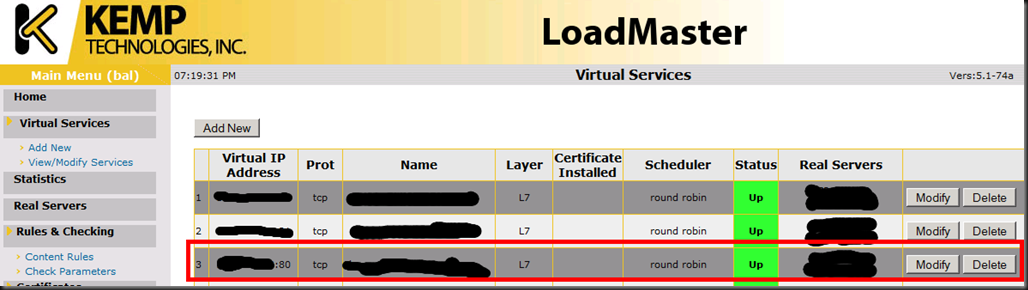
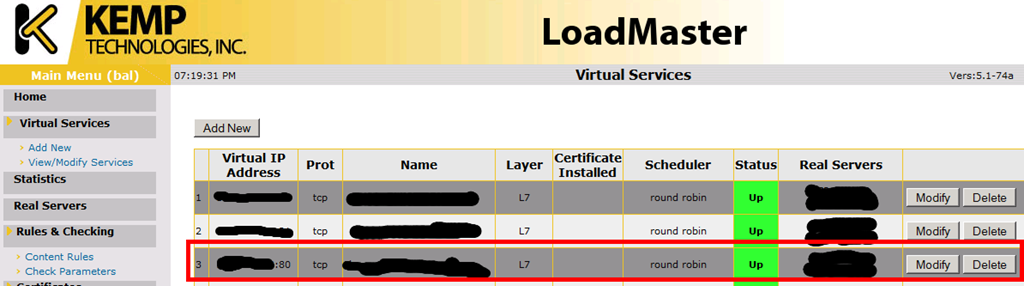
When checking the LoadMaster configuration, the virtual service for the web servers seemed well.
image

Is this a limitation of hardware load balancing or this specific Loadmaster? Some searching on the internet made it look like I was about the only on on the planet dealing with this issue so no help there.

Kemp Support Rocks

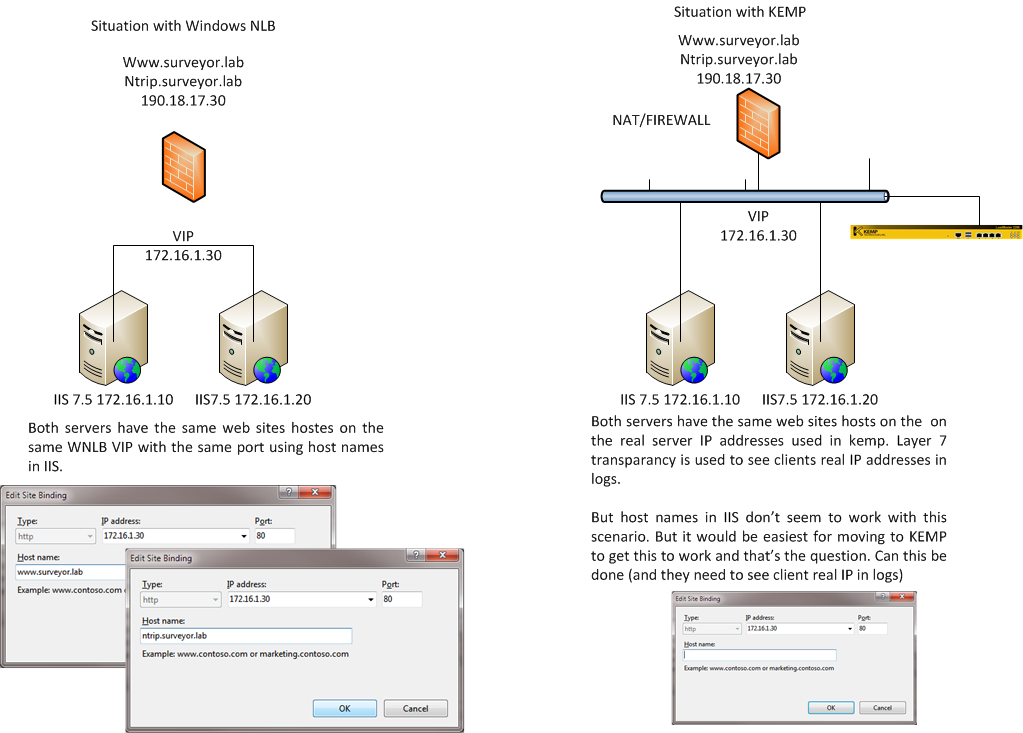
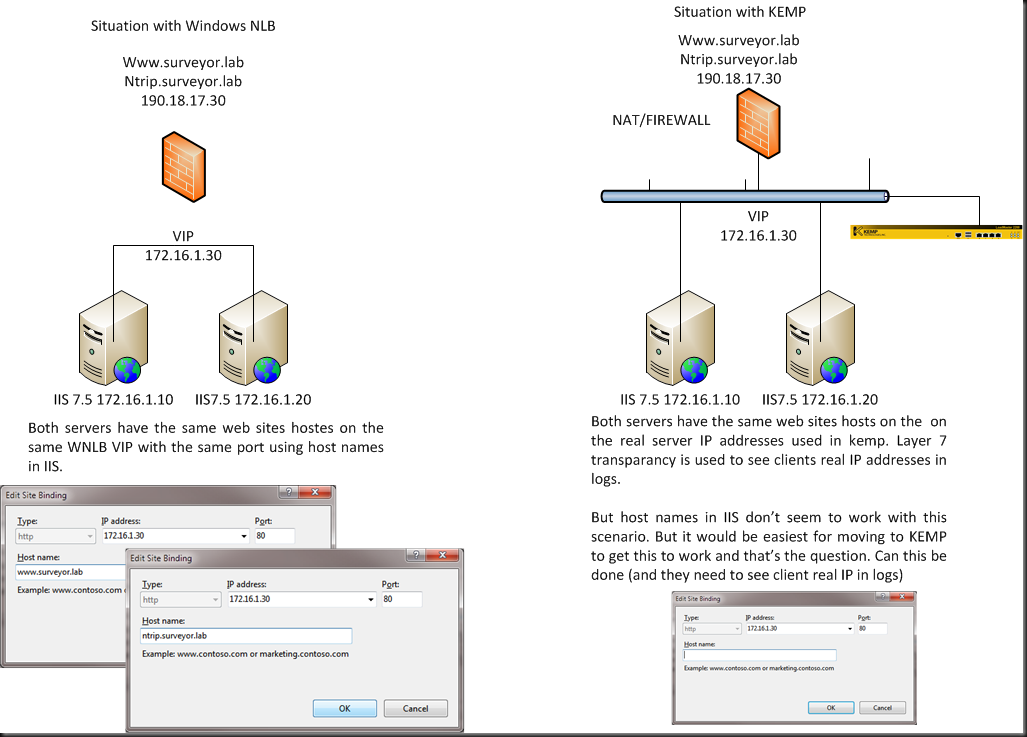
I already knew this but this experience reaffirms it. KEMP Technologies really does care about their customers and are very fast & responsive. I threw a quick question on twitter to @KempTech on Twitter and they responded very fast with some pointers. After that I replied with some more details, they offered to take it on via other means as twitter has it limits. OK, no problems. The next morning I got an e-mail from one of their engineers (Ekkehard) with more information and a request for more input from our side. I quickly made a VISIO diagram of the current and the desired situation. Based on this he let me know this should work.
image

He asked for a copy of the configuration and already pointed to the solution:

And what exactly happens – does the RS turn “red” in the “View/Modify Services” view? That might be caused by the health check settings…
(Remember that a 302 is considered NOT ok, so you had to enter the proper check URL and or / HTTP1.1 hostname)

But at that moment I did not realize this yet. I saw no error or the real server turning red indicating it was down. So we went through the configuration and decided to test without forcing layer 7 to see what happened. This didn’t make a difference and it wasn’t really a solution if it had as we needed layer 7 and layer 7 transparency.

Ekkehard also noticed my firmware was getting rather old (don’t fix what isn’t broken Smile) and suggest an upgrade (5.1-24 to 5.1.-74). So I did, reboot and tested some more settings. To make sure I didn’t miss anything I threw a network sniffer (WireShark) against the issue. And guess what?  As soon as I added a host name to the IIS web site bindings I didn’t even get any request from my client on that server anymore. So it was definitely being stopped at the Loadmaster. Without it request from a client came through perfectly.  That was not IIS doing as with a host name nothing came into the server. So why would the LoadMaster stop traffic to a real server? Because it’s down, that’s why, just like Ekkehard has indicated in one of his mails but we didn’t see it then.

Better check again and sure enough, the health service told me the real servers are down. Hey … that’s new. Did the previous firmware not show this, or just slower? I can’t say for sure. It’s either me being to impatient, a hiccup, the firmware or premature dementia Confused smile

Root Cause

So what happens? The default health check uses HTTP 1.0. You can customize it with a path like  /owa or such but in essence it uses the IP address of the real server and guess what. With a Host header name in IIS that isn’t allowed other wise it can’t figure out what website you want to go to if you’re using this feature to run multiple sites on the same IP address and port. So we need to check the health based on host name. Can the LoadMaster do that for us? Yes it can!

The fix

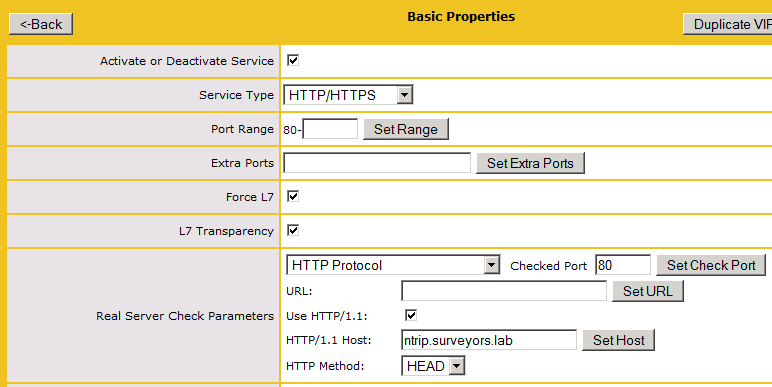
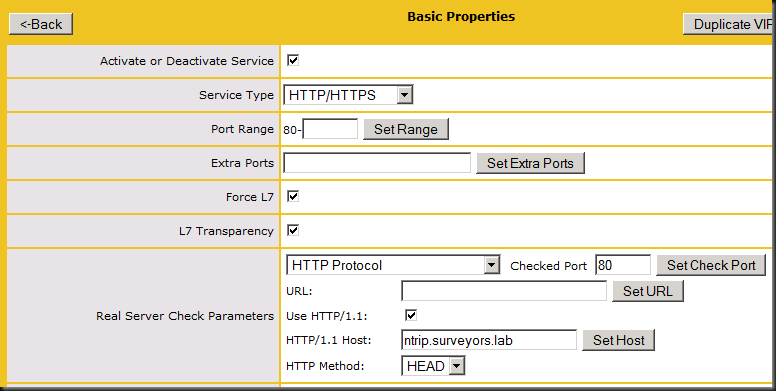
You need to enable HTTP 1.1 and fill out the host name you want to use for health checking.  In our case that’s ntrip.surveyor.lab. That’s all there’s to it. Easy as can be if you know. And Ekkehard knew he indicated to this in his quoted mail above.
HTTP1 1host


Lessons Learned

So how did I not know this? Isn’t this documented? Sure enough on page  56 of the LoadMaster manual it says the following:

7  HTTP  The LoadMaster opens a TCP connection to the Real Server on the Service port (port80). The LoadMaster sends a HTTP/1.0 HEAD request the server, requesting the page ―/‖.  If the server sends a HTTP response with a status code of 2 (200-299, 301, 302, 401) the LoadMaster closes the connection and marks the server as active.  If the server fails to respond within the configured response time for the configured number of times or if it responds with a different status code, it is assumed dead.  HTTP 1.0 and 1.1 support available, using HTTP 1.1 allows you to check host header enabled web servers.

Typical, you read the exact line of information you need AND understand it after having figured it out. Now linking that information (yes we always read all manuals completely Embarrassed smile) to the situation at hand isn’t always that fast a process but I got there in the end with some help from KEMP Technologies.

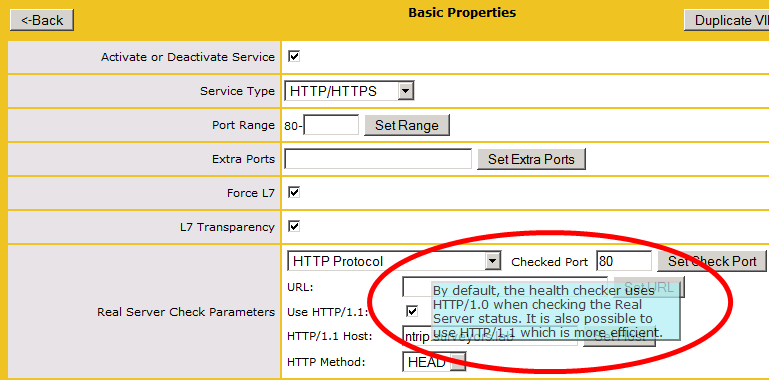
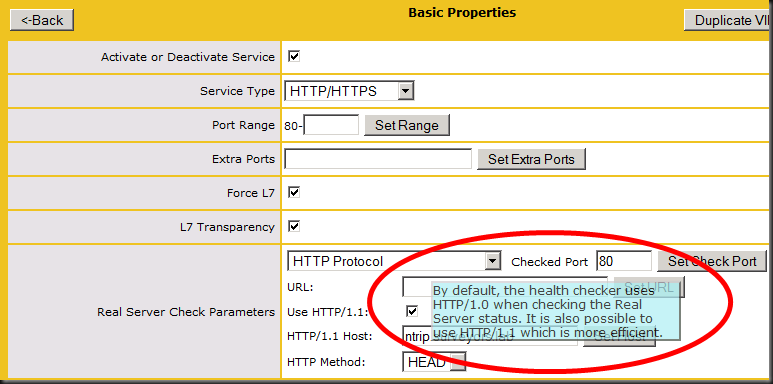
One hint is perhaps to mention this is in the handy tips that pop up when you hover over a setting in the LoadMaster console. I rely on this a lot and a mention of “HTTP 1.1 allows you to check host header enabled web servers” might have helped me out. But it’s not there. A very poor excuse I know … Embarrassed smile
image

Host Header Names & HTTP redirection

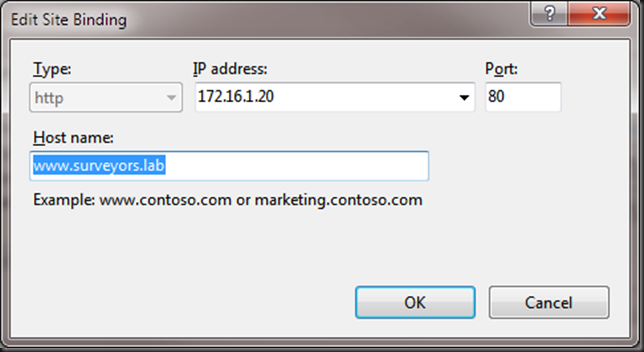
After having fix this issue I proceeded to configure HTTP redirect in IIS 7.5. For this is used two sites. One was just a fake site tied to the www.surveyors.lab hostname in IIS on port 80.
image

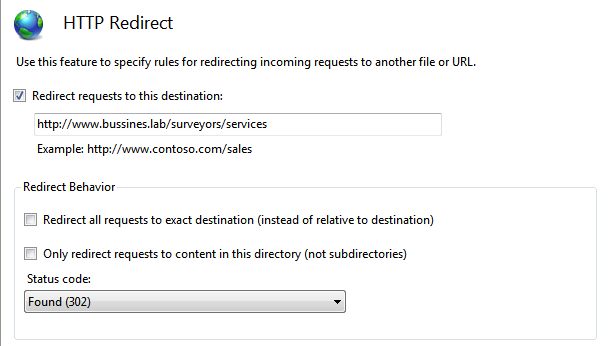
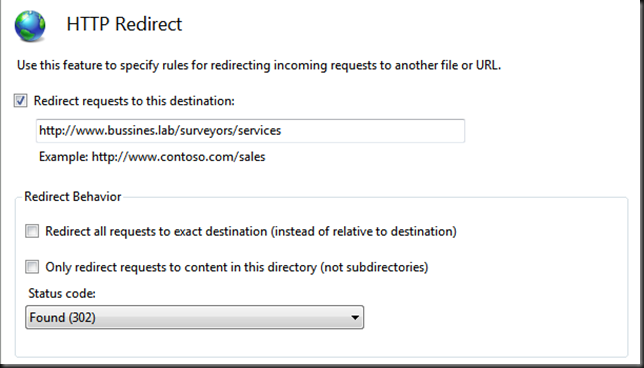
For this site I created a HTTP redirect to www.bussines.lab/surveyors/services. This works just fine as long as you don’t forget the http:// in the redirect URL.
image

So it has to be http://www.bussines.lab/surveyors/services or you’ll get a funky loop effect looking like this:

http://www.surveyors.lab/www.bussines.lab/surveyors/services/www.bussines.lab/surveyors/services/www.bussines.lab/surveyors/services

Firefox will tell you you have a loop that will never end but Internet Explorer doesn’t, it just fails. You do get that URL as a pointer to the cause of the issue. That is if you can relate it to that.

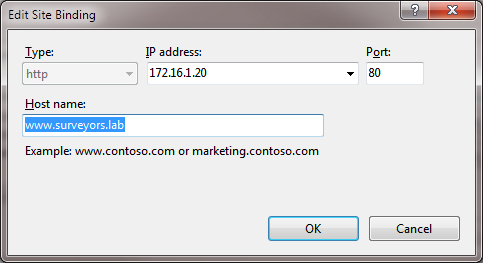
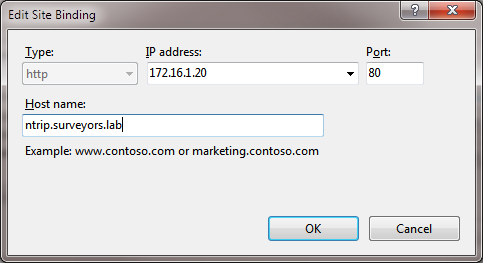
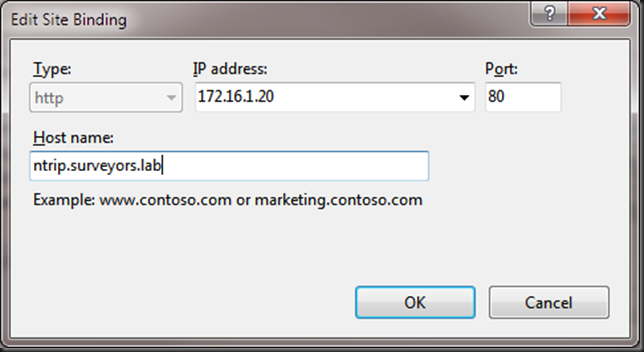
The other was the real site  and was configured with following bindings and without redirection.
image

Don’t forget to do this on all real servers in the farm! The next thing I need to find out is how to health check two host names in the LoadMaster as I have two websites with the same IP address, port but different host names.
Optimizing Live Migrations with a 10Gbps Network in a Hyper-V Cluster

Introduction

You’ll find the following recommendations on line about optimizing Live Migrations:

  1. Use bigger pipes (10Gbps is better than 1Gbps)
  2. Enable Jumbo Frames
  3. Up the Receive Buffer to 8192 (Exchange 2010 virtualization recommendation for Live Migration)

As we’ve been building Hyper-V Cluster since the early betas let me share some experiences with this. For the curious I used Intel® Ethernet X520 SFP+ Direct Attach Server Adapters & DELL PowerConnect 8024F 10Gbps switches for my testing. See my blog posts on considerations about the use of 10Gbps in Hyper-V clusters here:

  1. Introducing 10Gbps Networking In Your Hyper-V Failover Cluster Environment (Part 1/4)
  2. Introducing 10Gbps With A Dedicated CSV & Live Migration Network (Part 2/4)
  3. Introducing 10Gbps & Thoughts On Network High Availability For Hyper-V (Part 3/4)
  4. Introducing 10Gbps & Integrating It Into Your Network Infrastructure (Part 4/4)

Bigger pipes are better

On bigger pipes I can only say that if you can afford them and need them you should get them. End of discussion.

Jumbo frames rock

Jumbo frames help out a lot (+/- 20 %), especially with the larger memory virtual machines.

The golden nugget

So far so good, but there is one golden nugget of information I want to share. There is little trip wire that can prevent you from getting your optimal performance. Advanced power settings in the BIOS. If you read my blogs you might have come across a blog post Consider CPU Power Optimization Versus Performance When Virtualizing and I encourage you to go and read that post as it holds a lot of good info but also is very relevant to this post. Because we have yet another reason to make sure your BIOS is set right to achieve a decent return on investment in quality hardware.

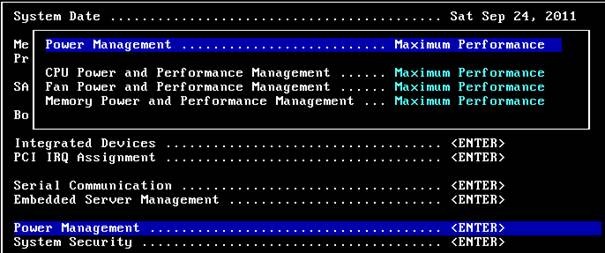
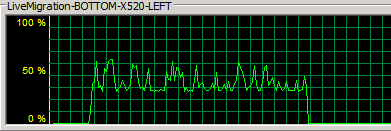
In our experience those power saving settings, the C states and the C1 states are also not very helpful when it comes to Live Migration & such. I got from a meager 20% bandwidth use all the way up to 35-45% at best with jumbo frames enabled and the power settings set to ”Full Power”. A lot better but still not very impressive.

clip_image002

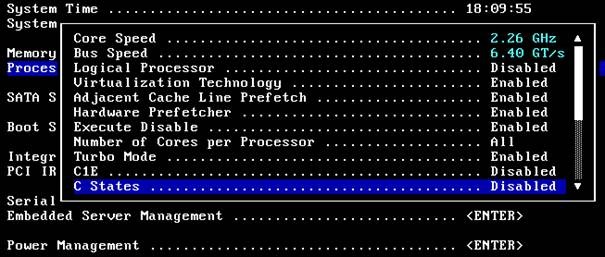
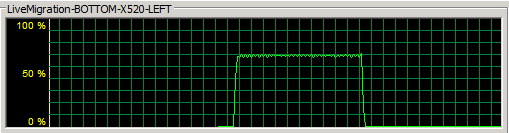
Now go ahead and disable the C states AND the C1E state to achieve 55% to 65%.

clip_image004

Now the speed of a live migration varies greatly between virtual machines that are idle or running a full load, both CPU & memory wise. It also depends on the load the host you’re migrating from and to, but this impact is less when you disable those advance CPU power settings.

Look at the following screen shots

clip_image005

A SQL Server with 50GB of RAM being live migrated over 10Gbps. Jumbo frames enabled, Power Settings optimized but with C1E & C States enabled.

clip_image006

A SQL Server with 50GB of RAM being live migrated over 10Gbps. Jumbo frames enabled, Power Settings optimized but with C1E & C States disabled.

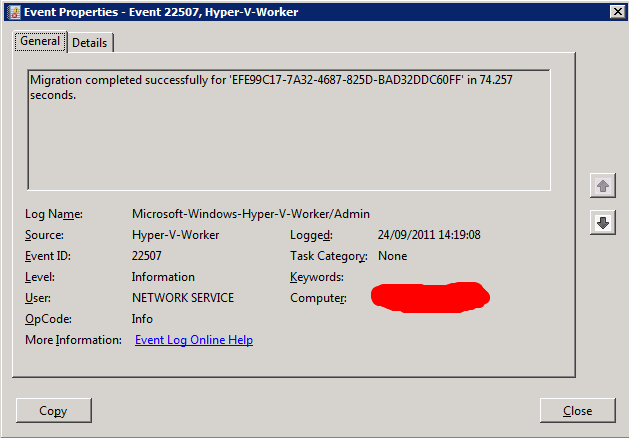
The live migration of this virtual SQL Server takes between 74-78 seconds. Not bad!

image

By the way these settings also help with 1Gbps but there is isn’t as spectacular. You use 99% instead of 75-80% of you bandwidth. And improvement yes, but not on the same scale as with 10Gbps for speeding up Live Migrations.

As you can see in this post on the TechNet support groups, this seems to be a common occurrence. It’s not just me who’s seeing things: Live Migration on 10GbE only 16%. even Dell chimed in there confirming these findings in their labs.

Receive Buffer

There is one setting that’s been advised for Exchange 2010 virtualization with Hyper-V that I have not seen improve speeds and that’s upping the Receive Buffer 8192. You can read this in Best Practices for Virtualizing Exchange Server 2010 with Windows Server® 2008 R2 Hyper V™. In some cases I tested this even reduces the results, especially when you have C1E & C states enabled. It is also a confusing recommendation as they state to set the Receive Buffer to 8192 .This value however is dependent on the NIC type and driver so you might only be able to set it to 4096 or so. The guidance should state to set it as high a possible but I have not seen any benefits. Do mind that I did not test this with a Hyper-V cluster running a virtualized Exchange 2010 guest. Your mileage may vary. Trust but verify is the age old adagio. Also keep in mind I’m running 10Gbps, so the effect of this setting might be not be what it could do for a 1Gbps network, but on the whole I’m not convinced. If you implement all other recommendations you’ll saturate a 1Gbps already.

What does this mean?

The sad news is that in virtual environments or other high performance configurations the penguins have to give way to performance. I wish it was different but unfortunately it isn’t.

By the way, this is vendor agnostic. You’ll see this with HP, DELL, CISCO in all form factors whether they are tower, rack or blade servers. The main thing you need to make sure is that the BIOS allows you to disable the C States en power settings. Not all vendors/BIOS version allow for this I read so make sure you check this. Some CISCO blades have annoying on this front, ruining the performance of VDI projects with less than optimal CPU performance but they have released an updated BIOS now to fix this.

Look, it makes no sense saving on power if it means you’ll by more servers to compensate for the lack of performance per unit. In my honest opinion a lot of all the hardware optimizations are awesome but they still have a long way to go in making sure it doesn’t incur such a hit even on performance. Right sizing servers in number & type of CPU, power supplies etc. still seems the best way to avoid waiting energy and money. Buying more power than needed and counting on the power consumption optimizations to reduce operating cost can be a good idea to protecting your investment for expected future increases in resource demand within the service life of your hardware. On average that is 3 to 5 years depending on the environment & needs.

Conclusion

Three things are needed for lightning fast Live Migrations:

  1. Bandwidth. Hence the 10Gbps network. There is no substitute for bigger pipes.
  2. Jumbo Frames. Configure them right & you’ll reap the benefits
  3. Disable C1E& C states. Also Configure your servers power options for maximum performance.
  4. I have not been able to confirm the receive buffer has a big impact on Live Migration speed or does any good at all. Test this to find out if it works for you

Remember that you’ll be able to do multiple Live Migrations in parallel with Windows 8. So a 10Gbps pipe will be used at full capacity then. Being able to use more networks for Live Migration will only increase the capability to evacuate a host fast or to move virtual machines for load balancing across a cluster. If you look at the RDMA, infiniband, 40/100Gbps evolutions becoming available in the next 12 to 36 months 10Gbps will become a lot more mainstream while at the same time the options for network connectivity will become more diversified. 10Gbps prices are dropping but for the moment they do remain high enough to keep people away.

System Center Virtual Machine Manager 2008 R2 Error 12711 & The cluster group could not be found (0×1395)

The Issues

I recently had to go and fix some issues with a couple of virtual machines in SCVMM 2008 R2. There was one that failed to live migrate with following error:

Error (12711)
VMM cannot complete the WMI operation on server HopelessVm.test.lab because of
error: [MSCluster_ResourceGroup.Name=" df43bf60-7216-47ed-9560-7561d24c7dc8"] The cluster group could not be found.

(The cluster group could not be found (0×1395))
 
Recommended Action
Resolve the issue and then try the operation again

Other than that it looked fine and could be managed with SCVMM 2008 R2. Another one was totally wrecked it seemed. It was in a failed state after an attempted live migration. You couldn’t do anything with it anymore. Repair was “available” but every option there failed so basically that was the end of the game with that VM. Both issues can be resolved with the approach I’ll describe below.

The Cause

After some investigation the cause of this was the fact that this virtual machine had been removed from the failover cluster as a resource was exported & imported using Hyper-V manager on one of the cluster nodes. It was then added back to the failover cluster again to make them high available. All this was done without removing it from SCVMM 2008 R2. By the way, as mentioned above in “The Issues” this can get even worse than just failing live migrations. The same scenario can lead to virtual machines going into a failed state that you can’t repair (retry or undo fail) or ignore and basically you’re stuck at that point. You can’t even stop, start, shutdown the virtual machine anymore, not one single operation works in SCVMM while in the failover cluster GUI and in hyper-v manager everything is fully operational. This is important to note, as the services are fully on line and functional. It’s just in SCVMM that you’re in trouble.

Why did they do it this way? They did it to move the VM to a new CSV. The fact that you delete the VM files when deleting a VM with SCVmm2008R2 made them use Hyper-V manager instead. Now this approach (whatever you think of it) can work but then you need to delete the VM in SCVMM2008R2 after exporting the virtual machine AND before proceeding with the import and making the virtual machine highly available.

People get creative in how to achieve things due to inconsistencies, differences in functionality between Hyper-V Manger and SCVMM 2008R2 (in the latter especially the lack of complete control over naming, files & folders, export/migration behavior) as well as the needs of the failover cluster can lead to some confusing scenarios.

The Supported Fix

Now the easy way to fix this is to export the virtual machine again and delete it in SCVMM 2008 R2. That will remove the virtual machine object from SCVMM, the failover cluster en Virtual Machine Manager. However this virtual machine was so large (50Gb + 750 GB data disk) that there was no room for an export to be made. Secondly an export of such a large VM takes a considerable time and it has to be off line for this operation. This is annoying as SCVMM might be uncooperative at this point, the virtual machine is online en performing it’s duties for the business. So this presented us with a bit of a problem. Stopping the virtual machine, Exporting it using Hyper-V Manager will cause it to go missing in SCVMM 2012 and then you can delete it, importing the virtual machine again and adding it to the failover cluster causes down time.

The Root Cause

Why does this happen? Well when you import a virtual machine into a failover cluster is creates a new unique ID for the virtual machine Resource Group . This happens always. Choosing to reuse an existing ID during import in Hyper-V Manager has nothing to do with this. But VMM uses ID/names to identify a VM, independent of the cluster. So when you did not remove the VM from SCVMM before adding the VM back to the cluster you get a different cluster group ID in the cluster than you have in SCVMM. They both have the same name but there is a disconnect leading to the issues described above.

By the way exporting & importing a VM without first removing the virtual machine from the failover cluster leads to some issues in the Failover cluster so don’t do that either Smile

The “No Down Time” Fix

This is not the first time we need to dive in to the SCVMM database to fix issues. One of my main beef about SCVMM other than inconsistency with the other tools and its lack of control & options in some scenarios is the fact that it doesn’t have enough self-maintenance intelligence & functionality. This leads to the workaround above which are slow and rather annoying or consist of messing around in the SCVMM database, which isn’t exactly supported. Mind you Microsoft has published some T-SQL to clean up such issues themselves. See You cannot delete a missing VM in SCVMM 2008 or in SCVMM 2008 R2 and RemoveMissingVMs. See also my blog SCVMM 2008 R2 Phantom VM guests after Blue Screen post on this subject.

The usual tricks of the trade like refreshing the virtual machine configuration in the failover cluster GUI don’t work here. Neither does the solution to this error described Migrating a System Center Virtual Machine Manager 2008 VM from one cluster to another fails with error 12711. The error is the same but not the cause.

# Add the VMM cmdlets
Add-PSSnapin microsoft.systemcenter.virtualmachinemanager

# Connect to the VMM server
Get-VMMServer –ComputerName MySCVMMServer.test.lab

# Grab the problematic VM and put it into the object $vm
$vm = Get-VM –name “HopelessVM”

#Force a refresh
refresh-vm -force  $vm

In the end we have to fix the mismatch between the VMResourceGroupID in failover cluster and SCVMM by editing the database.

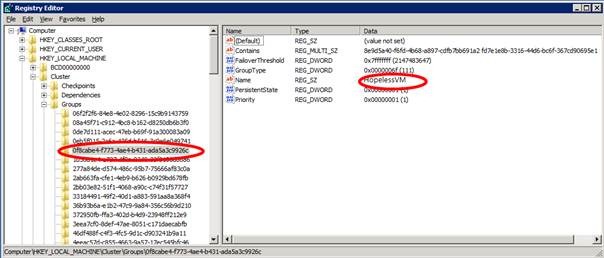
First you navigate to the registry key HKEY_LOCAL_MACHINEClusterGroups on one the cluster nodes, do a find for the problematic VM’s name and grab the name of its key, this is the VMResourceGroupID the cluster knows and works with? So now we have the correct VMResourceGroupID: 0f8cabe4-f773-4ae4-b431-ada5a3c9926c

clip_image002

Now you connect to the SCVMM database and run following query to find the VMResourceGroupID that SCVMM thinks that VM has and that it uses causing the issues

SELECT  VMResourceGroupID  FROM tbl_WLC_VMInstance WHERE ComputerName = 'hopelessVM.test.lab'
GO 

The results:

VMResourceGroupID

————————————————–

df43bf60-7216-47ed-9560-7561d24c7dc8

(1 row(s) affected)

The trick than is to simply update that value to the one you just got from the registry by running:

UPDATE tbl_WLC_VMInstance SET VMResourceGroupID = '0f8cabe4-f773-4ae4-b431-ada5a3c9926c' WHERE VMResourceGroupID = 'df43bf60-7216-47ed-9560-7561d24c7dc8'
GO 

Than you need some patience & refresh the GUI a few times. Things will turn back to normal, but in between you might seem some “missing” statuses appear for your problematic VM. These go away fast however. If not you can always use the Microsoft provided script to remove missing VM’s as mentioned above in RemoveMissingVMs.

Warning

What I described above is something you can do to fix these issues fast and effectively when needed. But I’m not telling you this is the way to go, let alone that this is supported. Make sure you have backups of your VMs, Hosts, SCVMM database etc. It only takes one mistake or misinterpretation to royally shoot yourself in your foot Winking smile. It hurts like hell; recovery is long and seldom complete. On top of that it might generate a vacancy in your company whilst you’re escorted out of the building. Be careful out there.