Migration LUNs to your Compellent SAN

A Hidden Gem in Compellent

As you might well know I’m in the process of doing a multi site SAN replacement project to modernize the infrastructure at a non disclosed organization. The purpose is to have a modern, feature reach, reliable and affordable storage solution that can provide the Windows Server 2012 roll out with modern features (ODX, SMI-S, …).

One of the nifty things you can do with a Compellent SAN is migrations from LUNs of the old SAN to the Compellent SAN with absolute minimal downtime. For us this has proven a real good way of migrating away from 2 HP EVA 8000 SANs to our new DELL Compellent environment. We use it to migrate file servers, Exchange 2010 DAG Member servers (zero downtime),  Hyper-V clusters, SQL Servers, etc. It’s nothing less than a hidden gem not enough people are aware off and it comes with the SAN. I was told that it was hard & not worth the effort by some … well clearly they never used and as such don’t know it. Or they work for competitors and want to keep this hidden Winking smile.

The Process

You have to set up the zoning on all SANs involved to all fabrics. This needs to be done right of course but I won’t be discussing this here. I want to focus on the process of what you can do. This is not a comprehensive how to. It depends on your environment and I can’t write you a migration manual without digging into that. And I can’t do that for free anyway. I need to eat & pay bills as well Winking smile

Basically you add your target Compellent SAN as a host to your legacy SAN (in our case HP EVA 8000) with an operating system type of “Unknown”. This will provide us with a path to expose EVA LUNs to our Compellent SAN.

image

Depending on what server LUNs you are migrating this is when you might have some short downtime for that LUN. If you have shared nothing storage like in an Exchange 2010 or a SQL Server 2012 DAG you can do this without any downtime at all.

Stop any IO to the LUN if you can (suspend copies, shut down data bases, virtual machines) and take CSVs or disks offline. Do what is needed to prevent any application and data issue, this varies.

What we then do is we unpresent the LUN of a server on the legacy SAN.

image

After a rescan of the disks on the server you’ll see that disk/LUN disappear.

This same LUN we then present to the Compellent host we added above.

image


We then “Scan for Disks” in the Compellent Controller GUI. This will detect the LUN as an unassigned disk. That unassigned disk can be mapped to an “External Device” which we name after the LUN to keep things clear (“Classify Disk as External Device” in the picture below).

image


Then we right click that External Device and choose to “Restore Volume from External Device”.

image

This kicks off replication from the EVA LUN mapped to the Compellent target LUN. We can now map that replica to the host as you can see in this picture.

image

After this rescan the disks on the server and voila, the server sees the LUN again. Bring the disk/CSV back online and you’re good to go.

image

All the downtime you’ll have is at a well defined moment in time that you choose. You can do this one LUN at the time or multiple LUNs at once. Just don’t over do it with the number of concurrent migrations. Keep an eye on the CPU usage of your controllers.

After the replication has completed the Compellent SAN will transparently map the destination LUN to the server and remove the mapping for the replica.

image


The next step is that the mirror is reversed. That means that while this replica exists the data written to the Compellent LUN is also mirrored to the old SAN LUN until you break the mirror.

image


Once you decide you’re done replicating and don’t want to keep both LUNs in sync anymore, you break the mirror.

image


You delete the remaining replica disk and you release the external disk.

image


Now you unpresent the LUN from the Compellent host on your old SAN.

image


After a rescan your disks will be shown as down in unassigned disks and you can delete them there. This completes the clean up after a LUN migration.

image


Conclusion

When set up properly it works very well. Sure it takes some experimenting to deal with some intricacies, but once you figure all that out you’re good to go and are ready to deal with any hiccups that might occur. The main take away is that this provides for minimal downtime at a moment that you choose. You get this out of the box with your Compellent. That’s a pretty good deal I say!

So as you can see this particular environment will be ready for Windows Server 2012 & Hyper-V. Life is good!

Windows Server 2012 Cluster in a Box as a New Form Factor?

Let’s look at “Cluster in a Box” (CiB)as a building block or a form factor. Let’s say you’ve committed to building a private/hybrid cloud for your organizations but you’re at the end of your hardware life cycle or you just don’t have the capacity right now to build it. What options do you have. Do you want to acquire storage, data connectivity network gear, servers, NICs with etc. or will you just buy CiB blocks to scale out as you go? Perhaps you’ll buy a Hyper-V fast track solution or if you’re really big a one or multiple containers.

I do think that the modular principle throughout the data center is pretty cool. The industry has done a great job at this with servers and smaller components as well as with the modular containers by SUN, HP, DELL.

clip_image002

While I do like and admire the concept of the “shipping container form factor” I do find it a couple of sizes too large to be practical for most of us. After all, let’s face it, we’re not all building public cloud service data centers. This means that between what we have seen today with server & storage modularity and the container form factor we’ve got a void. While some of these voids have been filled for specific applications like Exchange 2010 through custom build solutions by some vendors you cannot call this modular. Is a very application specific solution. The other, more generic, solution that has existed for a while now is the hardware that vendors deliver with the Hyper-V fast track we’ve mentioned already. Whiles these are nice, pre-configured solutions these are, again, not very modular. It’s not a complete unit that just needs to be hooked the network and provisioned with power. The time is ripe with the current state of Microsoft Windows Server 2012 to fill that void using the “Cluster in a Box” form factor. That would mean that in the future we could of the same benefits as the big players but at a size that’s fit for our purposes in the smaller data centers. This opens up a lot of scenarios for better efficiency.

What if the entire unit shipped to a customer contains everything packed away internally. That is servers, networking and storage. You just have to mount it in a rack, connect it to redundant power outlets and to redundant network paths. That’s it. Just power it up, fill out the wizard and be done with it. That’s all it takes to have a functional Hyper-V, Scale Out File System, SQL Server cluster etc. With the capabilities delivered by Windows Server 2012 this could very well be a scenario that might evolve. It’s more than just a business in or a branch office in a box. I can also be more that the Scale Out File Server unit for a private cloud solution. It just might be the first step of a new form factor building block for medium to even some large enterprises. If the economies are too good to be ignored I think this might happen.

clip_image004

The reason I think that this concept will work is that we have virtual machine mobility now so we no longer need to fear the isolation that silos might create. As a matter of fact this is a key element that might drive this. For the applications that are less suited for virtualization today we see two solutions. One is in the scalability of the Hyper-V platform with Windows Server 2012 and the other is the fact that the shared nothing approach is gaining popularity. It started with Exchange 2010 but is no also available with SQL Server 2012.

These clusters in a box can be made with existing servers (blades or not), storage and switches but I think there will be also new designs that are purpose build and not just existing hardware in a “rackable” box as in my drawings below Smile. Those boxes might have some scale up capability or come in different sizes

image

But scale out is the way that would make this work in the bigger environments, whatever the size of the Cluster in a Box.

image

Some SAN Storage Fun

At the end of this day I was doing some basic IO tests on some LUNs on one of the new Compellent SANs. It’s amazing what 10 SSDs can achieve … We can still beat them in  certain scenarios but it takes 15 times more disks. But that’s not what this blog is about. This is about goofing off after 20:00 following another long day in another very long week, it’s about kicking the tires of Windows and the SAN now that we can.

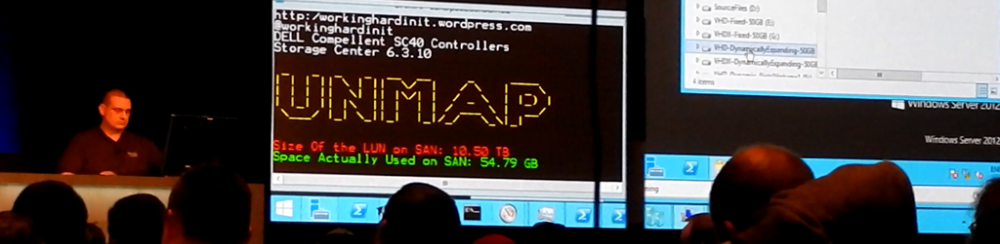
For fun I created a 300TB LUN on a DELL Compellent, thin provisioned off cause, I only have 250 TB Smile

I then mounted it to a Windows 2008 R2 test server.

image

The documented limit of a Volume in Windows 2008 R2 is 256TB when you use 64K allocation size. So I tested this limit by trying to format the entire LUN and create a 300TB simple volume. I brought it online, initialized it to an GPT disk, created a simple volume with an allocation unit size of 64K and well that failed with following error:

Failed Format300TB

There is nothing unexpected about this. This has to do with the maximum NTFS volume size supported on a GPT disk. It depends on the cluster size that is selected at the time of formatting. NTFS is currently limited to 2^32-1 allocation units. This yields a 256TB volume, using 64k clusters. However, this has only been tested to 16TB, or 17,592,186,040,320 bytes, using 4K cluster size. You can read up on this in Frequently asked questions about the GUID Partitioning Table disk architecture. The table below shows the NTFS limits based on cluster size.

image

This was the first time I had the opportunity to test these limits I formatted part of that LUN to a size close to the limit and than formatted the remainder to a second simple volume.

image

I still need get a Windows Server 2012 test server hooked up to the SAN. To see if anything has changed there. One thing is for sure, you could put at least 3 64TB VHDX files on a single volume in Windows. Not too shabby Smile. It’s more than enough to put just about any backup software into problems. Be warned, MSFT tested and guarantees performance & behavior up to 64TB in Windows Server 2012, but beyond that you’d better do your own due diligence.

The next thing I’ll do when I have a Windows Server 2012 host hooked up is, is create 64TB VHDX file and see if I can go beyond it before things break. Why, well because I can and I want to take the new SAN and Windows 2012 for a ride to see what boundaries we can push. The SANs are just being set up so now is the time to do some testing.

Hyper-V Shared Nothing Live Migration In Windows Server 2012– VM Mobility Rules

I see and hear some people shrug at the idea of Shared Nothing Live Migration, dismissing it as marginally useful. Some do state they’ll have it as well but that it’s not that valuable. Well I disagree totally. A lot of the time these remarks are due to a lack of understanding about how several technologies in the Microsoft stack work together. Combine this with tunnel vision and the fear of some vendors and you get a lot of FUD.

I advise you to look beyond the virtualization stack, to the issues that people who are building infrastructure for dynamic, flexible and * cloud  data centers are dealing with.

Look, as “architects” we have to design & build for failure. We all know that it’s just a matter of time before things go BOINK.  So we build in redundancy, some of this within a silo, some of this is between silos. The two approaches compliment each other. What this gives you is options and everybody who knows me, especially those who work  with me has heard my mantras: “Assumptions are the mother of all F* Ups” and “Options, options, options”. Make sure you design & build in options. This way you can maneuver your self out of a bad situation. Don’t ever assume you’re out of options, especially not when you put some in the design on purpose Winking smile. It’s also very useful beyond that because a lot of you might agree with me that silos and fork lift, down time inducing upgrades, migrations, transitions or replacements are expensive and bad. This is where Share Nothing Live Migrations comes into play. You gain mobility over silos. That silo might be a server, a cluster, storage or mixtures of them all.

With Shared Nothing Live Migration we can migrate virtual machines between those silos with nothing more than a network cable.This is huge people. You are no longer trapped in that silo. In this context it provides you with all the options & flexibility mobility gives you. even it the technology itself is not about high availability.

Some very useful scenarios

Migrate virtual machines from an old cluster to a new cluster with out any down time

  1. Migrate virtual machines from stand alone hyper-V hosts to a fail over cluster with out any down time
  2. Migrate virtual machines from one stand alone host to another one for maintenance, again, without any down time
  3. Choose different types if storage & Hyper-V deployment depending in IOPS, redundancy, availability, manageability needs. With Shared Nothing Live Migration you can be confident  that  you can move your virtual machine from one environment to the other when needs change. This is breaking the storage silo boundaries open people! This is huge … think about it.

How it works

The details are for another post but basically is made possible by the combination of Live Storage Migration and Live Migration.

First the Storage is Live Migrated

image

After the Live Storage Migration is done the state of the virtual machines is copied and synchronized.

image

This Is Mobility

I hear the competition shrug.  It isn’t high availability. Well indeed no one who understands the feature ever said it was. It’s virtual machine mobility. Look at the scenarios above and you’ll see that this ability could very well be game changer in how we look at storage & design solutions.

Speed & Performance

What did we hear on this front: “it will be too slow to be really useful”. Really? Well let’s see:

  1. The world is converging to 10Gbps and after that 40Gbps and up will come
  2. NIC Teaming in box With Windows 2012 which can provide more bandwidth.
  3. SMB 3.0 Multichannel. This provides multiple channels per connection spreading the load over multiple CPUs
  4. SMB Direct, have you seen the speeds this achieves?

Before you state that this doesn’t work on Live Migration … as confirmed at TechEd 2012 Europe with Jose Baretto this does work when both the source AND the target is an SMB 3.0 share. This means yet another reason to use SMB 3.0 share for your Hyper-V storage needs! So unlike what Tad at vLimited keeps saying, unhindered by any knowledge, it is a very valuable feature and it can be extremely fast given the right connectivity and storage that can handle the IOPS. And no, the fact that it’s unbuffered doesn’t impact this to much. Test this by using xcopy/robocopy /J with a VHD over your infrastructure.

image

Even if you’re on a budget and cannot go for the RDMA NICs & SMB 3.0 you have several options to get very decent virtual machine mobility and not be stuck in a silo. And for those who want to leverage this feature to create and agile & mobile virtual environment you have some very nice technologies available to optimize to your needs & budgets.

Conclusion

Virtual Machine mobility and storage mobility are very interesting features that provide for a previously unknown flexibility. Windows Server 2012 makes us rethink our storage approaches (I sure am) and I’m very interested in seeing how this will evolve.