Hyper-V Guest Storage Performance: Above & Beyond 1 Million IOPS

Making a million IOPS possible in a Windows Server 2012 Hyper-V VM

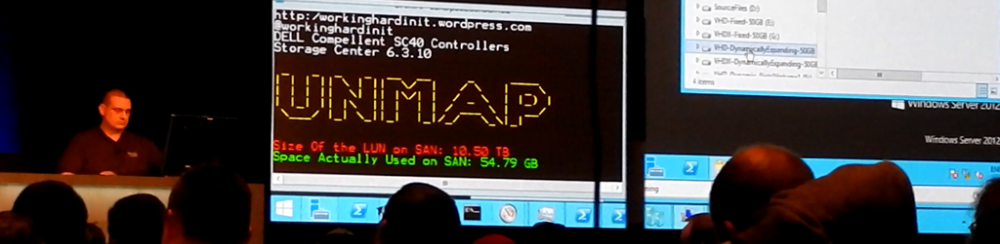
A lot of you will have seen the demos of a Hyper-V guest with VHDX disks running on Windows Server 2012 doing a million apps, if you haven’t yet, take a look here. While some quickly dismissed this as “irrelevant boasting” without real life relevance, I respectfully disagree. This is smart future proofing by Microsoft and provides a hypervisor ready for the future hardware capabilities and capable to handle the most demanding workloads today & in the years to come. Sure such a demo is under lab/ideal conditions and does not reflect the majority of real life environments but it’s nice to see what a hypervisor is capable of if and when you might need it. Remember there was a day that 4GB was a lot of RAM and 2TB sounded gigantic. Also remember that some people have larger needs than others.  Until Windows Server 2008 R2 you had some limitations in storage IO performance that would not allow for a million IOPS. These had to be addressed or all the efforts with regards to capabilities and performance in regard to storage, CPU, networking and memory would just hit those particular bottlenecks. So it is addressing real needs and indeed also smart future proofing.

Capabilities of virtual machine storage IO throughput in Windows 2008 R2

The capabilities listed below dictate the IO capabilities in virtual machines running on Windows Server 2008 R2 Hyper-V:

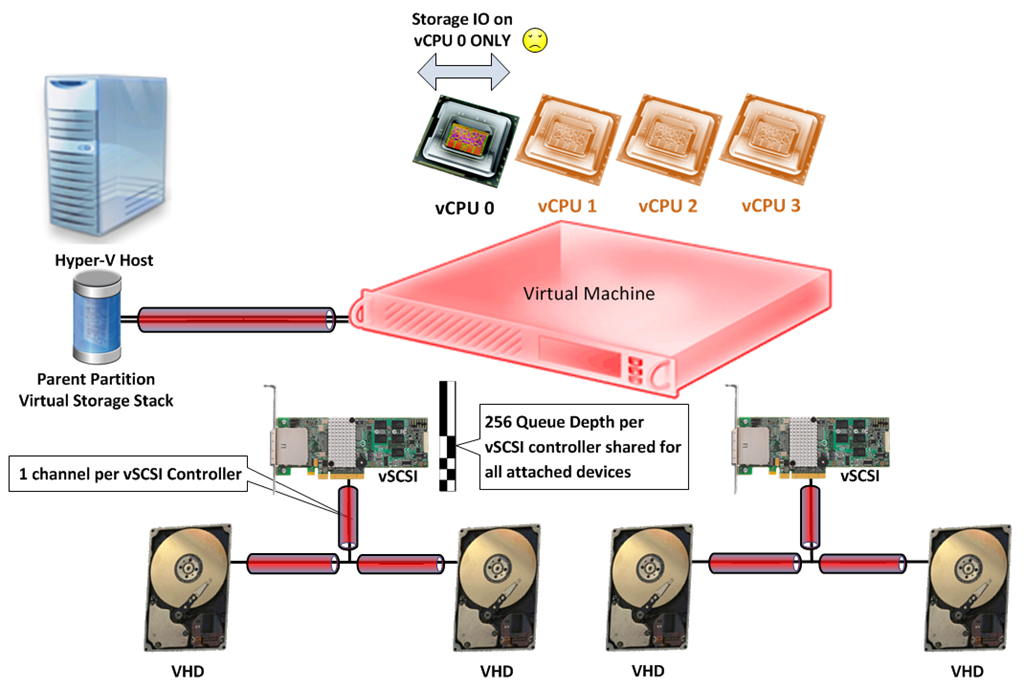
  1. Limited to one IO channel per virtual SCSI Controller
  2. 256 queue depth/SCSI for all devices attached to that SCSI adapter.
  3. There was one fixed vCPU (0) dedicated to handling IO.

image

The picture above illustrates these limits. You see two virtual SCSI Controllers each having 2 VHD virtual disks attached. Each disk shares the one channel the controller it is attached to has.

These limits could become a bottle neck but that was never was too big of a problem with a maximum of 4 vCPUs in Windows 2008 R2 Hyper-V. If needed for performance we might have attached VHDs to different virtual SCSI controllers for the best possible performance in Windows Server 2008 R2 Hyper-V .

With 64 vCPUs and ever more demanding workloads these limitations would become a (serious) issue so this needed to be addressed. If not, despite all other efforts in regards to the 4 big resources (memory, storage and network) in Windows 2012, this would remain the limiting factor of IOPS inside a virtual machine on Windows 2012.

Windows Server 2012 improvements to virtual machine storage IO scaling

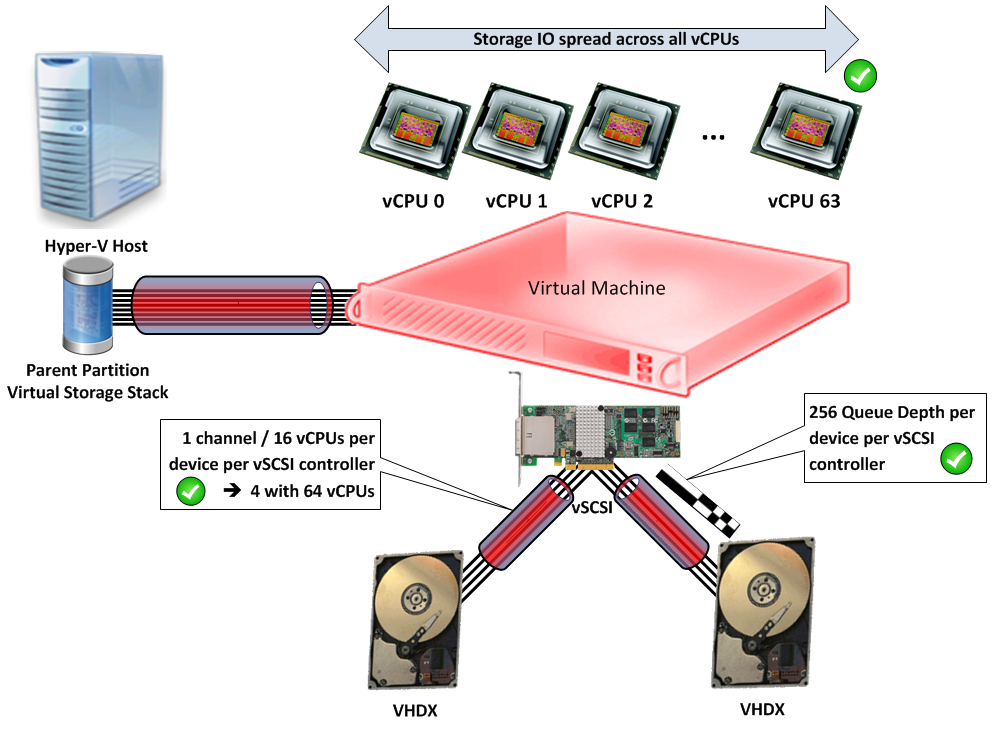
image

The picture above illustrates the improvements in Windows Server 2012 Hyper-V IO Scaling:

  1. There is now 1 channel per 16 vCPUs, per virtual SCSI device, per controller. So that means you have 4 channels, per VHDX attached to a virtual SCSI Controller when you have 64 vCPUs in the virtual machine. Compared to before, this is a significant improvement and a much needed one with the 64 vCPUs capability there is now.
  2. IO interrupt handling is now distributed amongst all vCPUs and this process is NUMA aware. This is a huge improvement!
  3. There is now a 256 queue depth/device attached to a specific SCSI adapter. That’s another big improvement.

That people, is how you get a virtual machine to handle a million IOPS. Nice! The questions or doubts whether Hyper-V can deliver the capacity, throughput & performance have been wiped of the table, yes also for virtual storage IOPS. You can now go straight to how it will address your business needs. From my experience it does so brilliantly and very cost effectively. Life might not be perfect but it is very good Smile

Quest Technical Experts Conference 2012 Europe Podcast

As the readers of my blog know I was in Barcelona this week to attend the Technical Experts Conference Europe 2012 organized by Quest (now a part of DELL).  Together with my fellow MVPs, friends and colleagues  Aidan Finn (@joe_elway), Carsten Rachfahl (@hypervserver) and Hans Vredevoort (@hvredevoort) we presented 8 sessions at the Virtualization Track and did a Hyper-V Experts panel to share what we have learned and help answer questions attendees on the new capabilities of Hyper-V in Windows Sever 2012. It was both fun and interesting to do. We learned some more from each other and also from the questions of an alert audience whom we enjoyed presenting to.

Mattias Sundling, a Technical evangelist at Quest and the owner of the Virtualization Track at TEC 2012 Europe did an audio podcast all 4 of us MVPs in the “Virtual Machine” expertise presenting in that track . You can find that podcast here on the vKernel/DELL web site http://www.vkernel.com/podreader/items/tec-europe-2012-mvps-with-mattias-sundling or on YouTube by clicking on the screenshot below. Enjoy.

image

Disk to Disk Backup Solution with Windows Server 2012 & Commodity DELL Hardware – Part II

As I blogged in a previous post we’ve been building a Disk2Disk based backup solution with commodity hardware as all the appliances on the market are either to small in capacity for our needs, ridiculously expensive or sometimes just suck or a combination of the above (Virtual Library Systems or Virtual Tape Libraries come to mind, one of my biggest technology mistakes ever, at least the ones I had and in my humble opinion Disappointed smile) .

Here’s a logical drawing of what we’re talking about. We are using just two backup media agent building blocks (server + storage)  in our setup for now so we can scale out.

image

Now in future post I hope to be discussing storage spaces & Windows deduplication thrown into the mix.

So what do we get?

Not to shabby …  > 1TB/Hour

image

To great …

image

In close up you are seeing just 2 Windows 2012 Hyper-V cluster nodes, each being backed up over a native LBFO team of 2*1Gbps NIC ports to one Windows Server 2012 Backup Media Agent with a 10Gbps pipe. Look at the max throughput we got  …

image

Sure this is under optimal conditions, but guess what? When doing backup from multiple hosts to dual backup media servers or more we’re getting very fast backups at very low cost compared to some other solutions out there. This is our backup beast Smile. More bandwidth needed at the backup media server? It has dual port 10Gbps that can be teamed and/or leverage SMB 3.0 multichannel. High volume hosts can use 10Gbps at the source as well.

Lessons learned

  • The Windows 2012 networking improvements rock. Upgrade and benefit from it! We’re seeing great results thanks to Multichannel leveraging RSS and in box NIC teaming (LBFO).
  • A couple of 1Gbps NICS teamed on Windows Server 2012 work really well. Don’t worry about not having 10Gbps on all your hosts.
  • Having 10Gbps on your backup media hosts (target) is great as you’ll be pushing a lot of data to them from multiple (source) hosts.
  • Make sure your backup software supports enough streams before it keels over under the load you’re pushing through. More streams means more concurrent files (read VHDs/VMs) and thus more throughput and allows multichannel to shine over RSS capable NICs.
  • Find the sweet sport for number of disks per node and total IOPS versus the throughput you can send to the backup media agents. 4 Nodes of 50TB might be better than 2 nodes of a 100TB. If you can, experiment a bit to find your optimal backup block size.
  • Isolate your backup network traffic from data traffic either physically or by other means (QOS) and don’t route it all over the place to end up where it needs to be.
  • We’re doing this using Dell PowerConnect 5424 (end of life) /5524 switches … no need for the real  high end very expensive gear to do this. The 10Gbps switch, well yes that’s always high end at the moment.
  • Use JBODS with SAS/Storage spaces & you’ll be fine. Select them carefully for performance. You can use bays like the MD3X00 if you want to replicates the backups somewhere otherwise MD12x0 will do or any other decent JBOD => even cheaper. You can also mix, some building blocks that can replicate & other on Storage Spaces /JBOS. Mix and match with different backup needs means you have flexibility. Note that at TechEd Europe (June 2012), in a session by DELL, they mentioned the need for a firmware update with the MD1200 to optimize performance with Storage Spaces.

It’s all about the money in a smart way!

As I said before, you will not get fired for:

  • Increasing backup throughput at least 4 fold (without dedupe)
  • Increasing backup capacity 3.5 fold (without deduplication)
  • Doing the above for 20% of systems that are replaced & new offerings with specialized appliances (even at hilarious discount rates). That’s CAPEX reduction.
  • This helps pay for the primary storage, DRC site & extra SAN for data replication in case of disaster
  • Make backups faster, more reliable & reduce OPEX (The difference for us is huge and important)
  • Putting an affordable scale up & scale out Disk2Disk backup solution into place to the business can safely handle future backup loads as very acceptable costs.
  • It’s a modular solution which we like. On top of that it’s about as zero vendor lock in as it gets. You can mix servers, bays, switches. Use what you like best for your needs. Only the bays have to remain the same within an individual “building block”.

Cost reduction is one thing but look at what we get whilst saving money… wow!

What am I missing?  Specialized dedupe. Yes, but we’re  going for the poor mans workaround there. More on that later.  As long as we get enough throughput that doesn’t hurt us. And give the cost we cannot justify it + it’s way to much vendor lock in. If you can’t get backups done without, sure you might need to walk that route. But for now I’m using a different path. Our money is better spend in different places.

Now how to get the same economic improvements from the backup software? Disk capacity licensing sucks. But we need a solution that can handle this throughput & load , is reliable, has great support & product information, get’s support for new release fast after RTM (come on CommVault, get a move on) and is simple to use ==> even more money and time saved.

Spin off huge file server project?

Why is support for new releases in backup software important. Because the lack of it is causing me delays. Delays cost me, time, money & opportunities. I’m really interested to covert our large LUN file servers to Windows Server 2012 Hyper-V virtual machines, which I now can rather smoothly thanks to those big VDHX sizes that are possible now and slash the backup times of those millions of small files to pieces by backing them up per VHDX over this setup. But I’ll have to wait and see when CommVault will support VHDX files and GPT disks in guests because they are not moving as fast as a leading (and high cost) product should. Altaro & Veeam have them beaten solid there and I don’t like to be held back.

Trouble Shooting Windows Server 2012 host based CommVault Backups with DELL Compellent hardware VSS provider of Hyper-V guests: ‘Microsoft Hyper-V VSS Writer’ State: [5] Waiting for completion

We have been running CommVault Simpana 9.0 R2 SP7 in combination with the DELL Compellent Hardware VSS provider to do host based backups of the virtual machines on our Windows Server 2012 Hyper-V clusters host with great success and speed.

We’ve run into two issues so far. One, I blogged about in DELL Compellent Hardware VSS Provider & Commvault on Windows Server 2012 Hyper-V nodes – Volume Shadow Copy Service error: Unexpected error querying for the IVssWriterCallback interface. hr = 0×80070005, Access is denied was an due to some missing permissions for the domain account we configured the Compellent Replay manager Service to run with. The solution for that issue can be found in that same blog post.

The other one was that sometimes during the backup of a Hyper-V host we got an error from CommVault that put the job in a “pending” status, kept trying and failing. The error is:

Error Code: [91:9], Description: Volume Shadow Copy Service (VSS) error. VSS service or writers may be in a bad state. Please check vsbkp.log and Windows Event Viewer for VSS related messages. Or run vssadmin list writers from command prompt to check state of the VSS writers.

clip_image001

When we look at the Compellent controller we see the following things happen:

  • The snapshots get made
  • They are mounted briefly and then dismounted.
  • They are deleted

The result at the CommVault end is that the job goes into a pending state with the above error. When we look at the state of the Microsoft Hyper-V VSS Writer by running “vssadmin list writer” …

image

… from an elevated command prompt we see:

Writer name: ‘Microsoft Hyper-V VSS Writer’
…Writer Id: {66841cd4-6ded-4f4b-8f17-fd23f8ddc3de}
…Writer Instance Id: {2fa6f9ba-b613-4740-9bf3-e01eb4320a01}
…State: [5] Waiting for completion
…Last error: Retryable error

Note at this stage:

  1. Resuming the job doesn’t help (it actually keep trying by itself but no joy).
  2. Killing the job and restarting brings no joy. On top of that our friendly error “Volume Shadow Copy Service error: Unexpected error querying for the IVssWriterCallback interface. hr = 0×80070005, Access is denied.“ is back, but this time related to the error state of the ‘Microsoft Hyper-V VSS Writer’. The error now has changed a little and has become:

clip_image002


Writer name: ‘Microsoft Hyper-V VSS Writer’
…Writer Id: {66841cd4-6ded-4f4b-8f17-fd23f8ddc3de}
…Writer Instance Id: {2fa6f9ba-b613-4740-9bf3-e01eb4320a01}
…State: [5] Waiting for completion
…Last error: Unexpected error

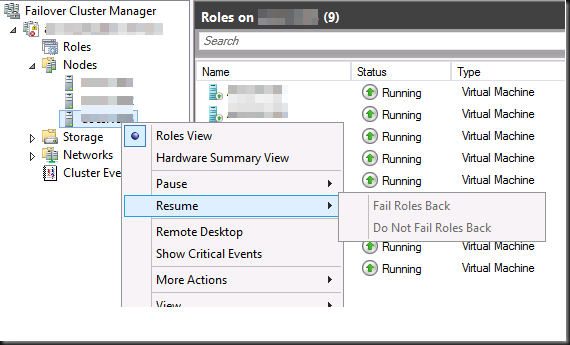
To get rid of this one we can restart the host or, less drastic, restart the Hyper-V Virtual Machine management Service (VMMS.exe) which will do the trick as well.  Before you do this , drain the node when you pause it, then resume it with the option failing back the roles. Windows 2012 makes it a breeze to do this without service interruption Smile

image

clip_image003

image

The Cause: Almost or completely full partitions inside the virtual machines

Looking for solutions when CommVault is involved can be tedious as their consultancy driven sales model isn’t focused on making information widely available. Trouble shooting VSS issues can also be considered a form of black art at times. Since this is Windows 2012 RTM an the date is September 20th 2012 as the moment of writing, there are not yet any hotfixes related to host level backups of Virtual machines and such. CommVault Simpana 9.0 R2 SP7 is also fully patched.

This,combined with the fact that we did not see anything like this during testing (and we did a fair amount) makes us look at the guests. That’s the big difference on a large production cluster. All those unique guests with their own history. We also know from the past years with VSS snapshots in Windows 2008(R2) that these tend to fail due to issues in the guests. Take a peak at Troubleshoot VSS issues that occur with Windows Server Backup (WBADMIN) in Windows Server 2008 and Windows Server 2008 R2 just for starters  As an example we already had seen one guest (dev/test server) that had 5 user logged in doing all kinds of reconfigurations and installs go into save mode during a backup, so it could be due to something rotten in certain guests. There is very much to consider when doing these kinds of backups.

By doing some comparing of successful & failed backups it really looks as if it was related to certain virtual machines. A lot of issues are caused by the VSS service, not running or not being able to do snapshots because of lack of space so perhaps this was the case here as well?

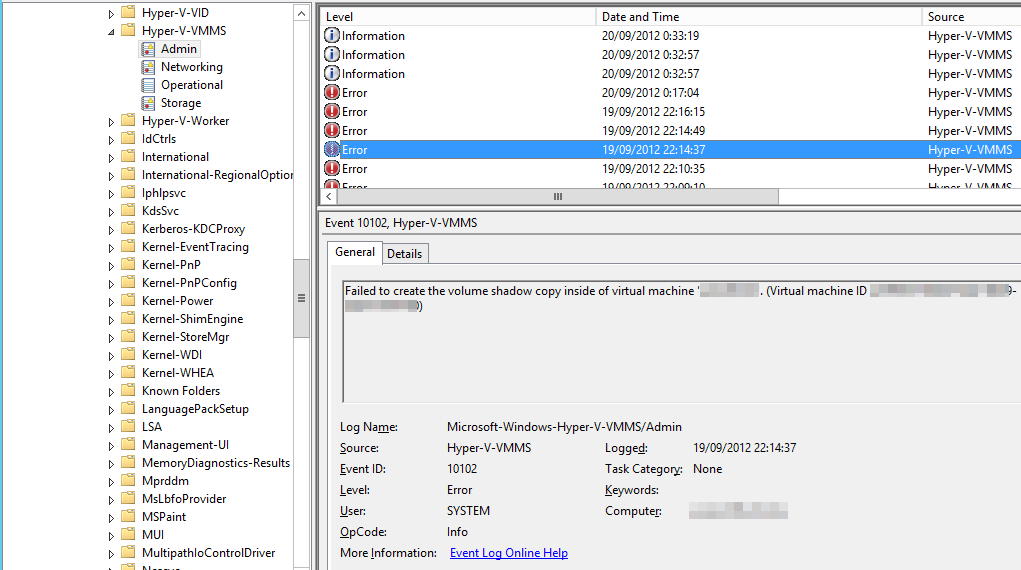
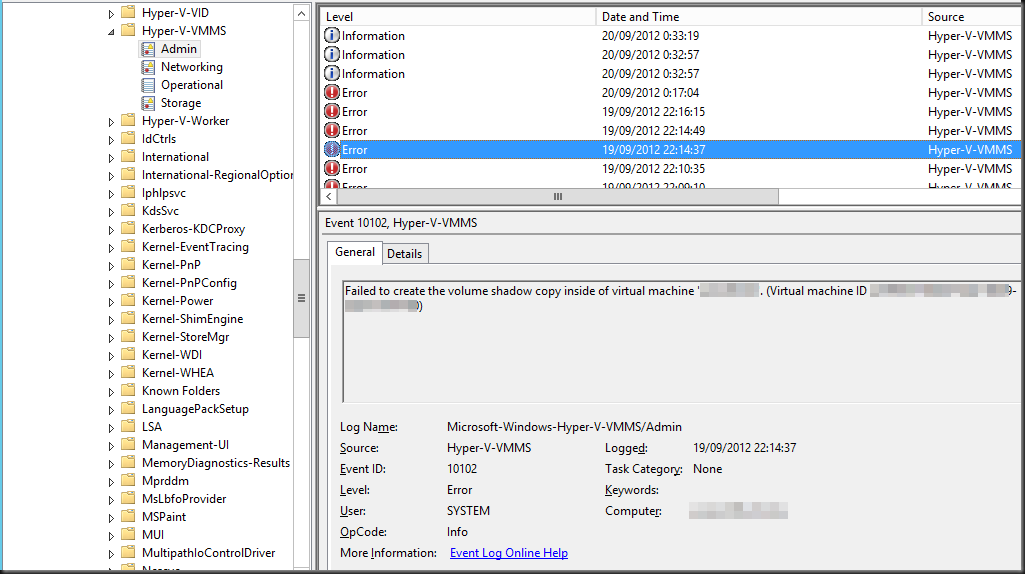
We poked around a bit. First let’s see what we can find in the Hyper-V specific logs like the Microsoft-Windows-Hyper-V-VMMS-Admin event log. Ah lot’s of errors relating to a number of guests!
image

Log Name:      Microsoft-Windows-Hyper-V-VMMS-Admin
Source:        Microsoft-Windows-Hyper-V-VMMS
Date:          19/09/2012 22:14:37
Event ID:      10102
Task Category: None
Level:         Error
Keywords:     
User:          SYSTEM
Computer:      undisclosed server
Description:
Failed to create the volume shadow copy inside of virtual machine ‘undisclosedserver’. (Virtual machine ID 84521EG0G-8B7A-54ED-2F24-392A1761ED11)

Well people, that is called a clue Winking smile. So we did some Live Migration to isolate suspect VMs to a single node, run backups, see them fail, do the the same with a new and clean VM an it all works. and indeed … looking at the guest involved when the CommVault backup fails we that the VSS service is running and healthy but we do see all kind of badness related to disk space:

  • Large SQL Server backup files put aside on the system partition or or other disks
  • Application & service pack installers left behind,
  • Log and tempdb volumes running out of space.
  • Application Logs running out of control

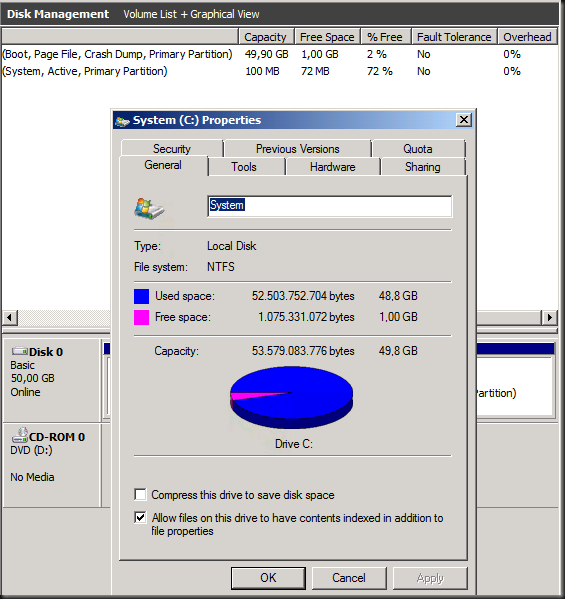
That later one left 0MB of disk space on the system (Test Controller TFS shitting itself), but we managed to clear just enough to get to just over 1GB of free space which was enough to make the backup succeed.

clip_image001[8]

image

Servers, virtual or physical ones, should to be locked down to prevent such abuse. I know, I know. Did I already tell you I do not reside in a perfect world? We cannot protect against dev and test server admins who act without much care on their servers. We’ll just keep hammering at it to raise their awareness I guess. For end users and production servers we monitor those well enough to proactively avoid issues. With dev & test servers we don’t do so, or the response team would have a day’s work reacting to all alerts that daily dev & test usage on those servers generate.

The fix

  • Clear at least 1GB or a bit more inside each partition in the guest running on the host that has a failing backup. I prefer to have at least a couple of GB free  (10% to 15% => give yourself some head room people).
  • Then you can resume the backup job manually or let CommVault do that for you if it’s still in a pending state.
  • If you’ve killed the job make sure you restore the
  • Microsoft Hyper-V VSS Writer  to a healthy state as described above. Thanks to Live Migration this can be achieved without any down time.

Conclusion

There is experimenting, testing, production testing, production and finally real life environments where not all is done as it should be. Yes, really the world isn’t perfect. Managers sometimes think it’s click, click, Next, click and voila we’ve got a complex multisite system running. Well it isn’t like that and you need some time and skills to make it all work. Yes even in todays “cheap, fast, easy to run your business form your smartphone”  ecosystem of the private, hybrid and public cloud, where all is bliss and world peace reigns.

The DELL Compellent Hardware VSS provider & replay manager service handle all this without missing a beat, which is very comforting. As previous experiences with hardware VSS provides of other vendors make us think that these would probably have blown up by now.