My TechDays 2013 Agenda Recommendations

As you all know by know the TechDays 2013  are approaching fast.  I have mentioned this before. There is still time to secure yourself a seat and attend this event. People for far and away are coming over for this so why not you?

You’ll gain insights into a lot of new technologies. You can decide to go deep or broad or any combination of these two options. The idea is that you can return to your desk and have a better understanding of Windows Server 2012, Hyper-V, Windows 8, System Center and what a private cloud can do for you and your business.

I know several speakers and they are aiming to offer you some practical knowledge so you can get a head start with these technologies. Understanding the concepts about and the principles behind sometimes abstract subjects is important. This is also true for a healthy mix of real life experiences, tips on how to get thing working and what to look out for. I hope the local community speakers can help you out there. But to do so you need to show up Smile. Sure you can watch on line sessions and download presentations. But consider being able to talk to the speakers and experts at the Microsoft boot, to have the opportunity to sit down for a talk about real live experiences and openly discuss your needs and concerns. No, it’s not free consultancy, it’s talking amongst peers who are often dealing with the same issues as you are which can help you decide what routes to explore further.

The complete agenda is available on line here.

Tuesday 5 March

Register for the track of your choice here. Hard choice between the security track and Exchange 2013 but I’m leaning towards the latter. Scott Schnoll & Michael Van Horenbeeck (Belgian MEET member and MVP for Exchange) are presenting.

Wednesday 6 March

08:45 – 10:15

This slot is easy, grab the keynote to set the tone for the TechDays.

IT Pro Keynote

10:45 – 12:00

Systems Center user and ready for Windows Server 2012? Attend  Vijay Tewari’s session.

What’s new System Center 2012 SP1, VMM

13:00 – 14:15 & 14:30 – 15:45

Easy choice. Windows 8 is not weird or hard to learn at all.For the small effort of educating yourself on this subject by attending these two sessions by a very knowledgeable MVP and great presenter Tom Decaluwé, you’re ahead of the pack, reaping the benefits while ignoring the drama.

Windows 8 Client Part 1 "The OS internals for IT-Pro’s"

Windows 8 Client Part 2 "The Application internals for IT-Pro’s"

16:15 – 17:30

I’m torn here. Chris Jackson is the guru on this subject and if you’re still running on XP and need to move to Windows 8 or even Windows 7 attend his session and learn how to thrive and not just survive such an project!
App Compat for Nerds

Hyper-V is very dear to me and it’s an interesting subject so if you are using or considering to use Hyper-V go listen to Bryon Surace and learn why dynamic memory is a lot more & better than over commitment!

Hyper-V Dynamic Memory in Depth

17:45 – 19:00

This is a Inovativ (Kenny Buntinx, Dieter Wijckmans, Kurt Van Hoecke) tidal wave of knowledge it seems with a twist of Mike Resseler (always a good thing)

What’s new and improved in Service Pack 1 for the System Center 2012 suite

19:00 – 21:00

Grab the people you think could help your with that question burning inside your head. Don’t be shy! Mingle amongst your peers and engage in some tech talks.

Ask the Experts and Networking

Thursday 7 March

09:00 – 10:15

Start of the day with a true scholar and gain knowledge & understanding on Active Directory in Windows Server 2012. If you were not awake yet, you will be 5 minutes into this session as John Craddock knows how to captivate an audience.

What’s new in Windows Server 2012 Active Directory?

10:45 – 12:00

If you’re going to deploy SCVMM 2012 SP1 you absolutely have to attend this session. Really, I mean it! Vijay Tewari presenting.

Network Management in System Center 2012 SP1 – VMM

13:00 – 14:15

You need it, you want it, you love it in Windows 2012. What? PowerShell of cause and Kurt Roggen will show you why.

The Power of PowerShell: Advanced

14:30 – 15:45

Some of the great additions to the capabilities of virtualization in Windows Server 2012 evolves around the support Active Directory. Better & saver than ever with a lot less fine print. Join Wim Henderyckx & Benjamin Logist.

Forbidden fruits of Active Directory – Cloning, snapshotting, virtualization

16:15 – 17:30

You’ll just have to understand that for practical reasons I have to kind of attend my own session. It’s the nature of presenting.

Windows Server 2012 Hyper-V Networking Evolved

Understanding Virtual Machine Priority and Preemption Behavior

Introduction

By reading Aidan Finn his blog You Pause A Clustered Hyper-V Host And Low Priority VMs are QUICK MIGRATED! you will learn something about how virtual machine priorities work during the pausing and draining of a clustered Hyper-V host. They are either Live or quick migrated depending on the value of the MoveTypeThreshold cluster parameter for resources of the type “Virtual Machine”. By default it’s at 2000 and that happens to be the value of the virtual machine priority “Low”.

Changing this value can alter the default behavior. For example setting the MoveTypeThreshold value to 1000 using PowerShell

Get-ClusterResourceType “Virtual Machine” | Set-ClusterParameter MoveTypeThreshold 1000

makes sure that only VMs with a priority set to “No Auto Restart”  are quick migrated. The  low priority machines would than also live migrate where by default they quick migrate.

  • Virtual Machines with Priority equal to or higher than the value specified in MoveTypeThreshold will be moved using Live Migration.
  • Virtual Machines with Priority lower than the value specified in MoveTypeThreshold will be moved using Quick Migration.

Virtual Machine Priorities
3000 = High
2000 = Medium
1000 = Low
0 = Virtual machine does not restart automatically.

Another Scenario to be aware of  to avoid surprises

Note that al this also comes into play in other scenario’s. One of them is when you attempt to start a guest that requires more resources than available on the host. Preemption kicks in and the lower priority virtual machines go into a saved state.  If you didn’t plan for this it could be a bit of a surprise, causing service interruption. What’s also important to know is that preemption kicks in even when there is no chance that putting lower priority virtual machines into saved mode will free enough resources for (all) the VMs you’re trying to start. So that service interruption might do you no good. If this is the case the Low priority VMS come back up when there are sufficient resources left.  Do note however that the ones set top “No Auto Restart” remain in a saved state. Look below for an example on how this could happen.

How does this happen?

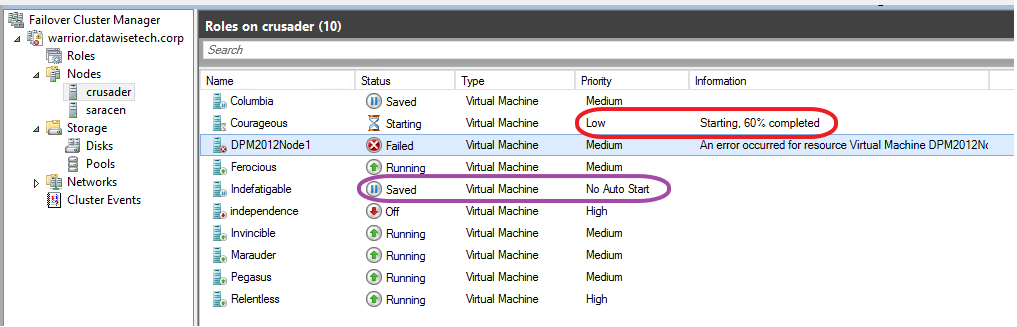
Let’s say you have a brand new VM that has gotten 16GB of RAM as requested by the business. When that large memory guest starts it will fail due to the fact that there are not enough memory resources available on the host that only has 16GB available. But as it attempts to start, the need for memory resources is detected and preemption comes into play. The guests with “Low” and “No Auto Restart” priorities are put into a saved state as the large memory VM has the default medium priority and the MoveTypeTreshold is at the default of 2000. You need to be ware of this behavior. Preemption kicks in and the machines are still saving while starting the large memory VM has already failed as they couldn’t free enough resources anyway.

image

The good new is that, as you can see below, is that the low priority guest starts again after starting the large memory guest has failed. No use keeping it saved as it can run and service customers. So the service interruption for this VM is limited but it does happen. Please also note that the guest set to No Auto Restart doesn’t come up again as it’s priority status says exactly that. So, this one becomes collateral damage.

image

As you can see it’s important to know how priorities and preemption work together and behave. It also good to know that changing the threshold come into play in more situations that just pausing & draining a host of during a fail over. While the cluster will try it’s best to keep as many VMs up and running you might have some unintended consequences under certain conditions. A good understanding of this can prevent you from being bitten here. So build a small cheap lab so you can play with stuff. This helps to gain a better understanding of how features work and behave. If you want to play some more, set the priority of the memory hungry VM to high you’ll see even more interesting things happen.

Exploring Hyper-V Virtual Switch Port Mirroring

Windows Server 2012 brings us many new capabilities and one of those is port mirroring. You can now configure a virtual machine NIC (vNIC) who’s traffic you want to monitor as the source in the Advanced Features of the Network Adapter settings. The vNIC of the virtual machine where you’ll run a network sniffer, like Network Monitor or WireShark, against is set to “Destination”. It’s pretty much that simple to set up. Easy enough.

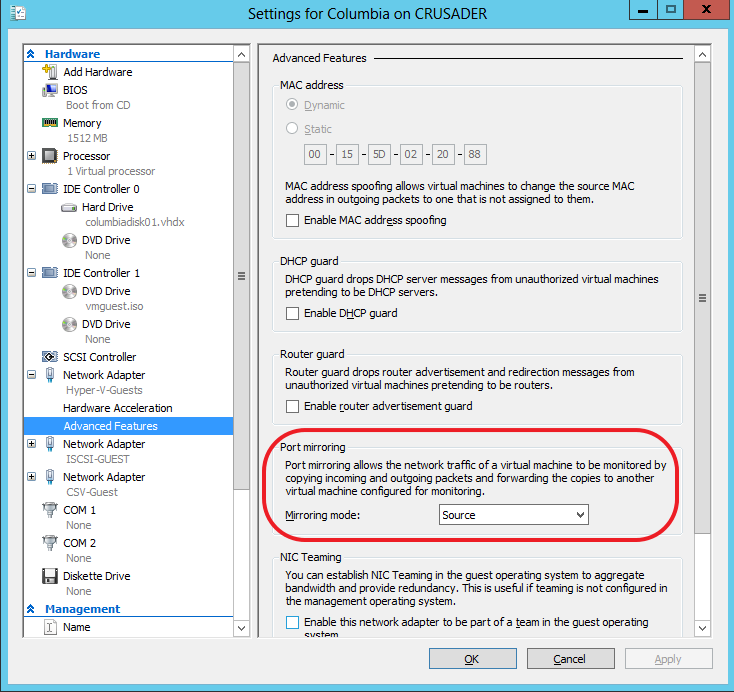
On the vNIC you want to monitor the traffic to and from the VM, under Settings, Network Adapter (choose the correct one), under Advanced Features you select “Source” as Mirroring mode. In this example we’re going to monitor data traffic to and from the guest Columbia.image

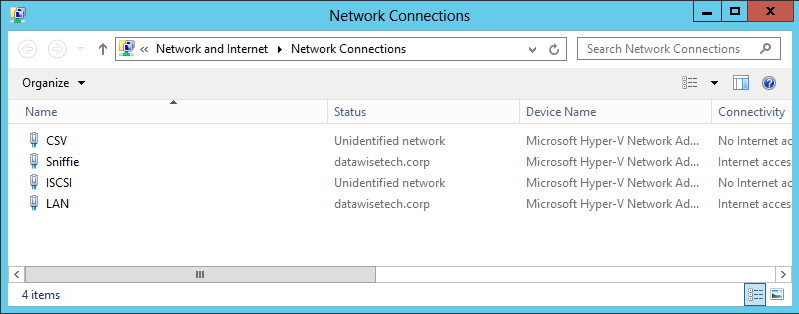
On the destination VM we have a dedicated vNIC set up called “Sniffie”image

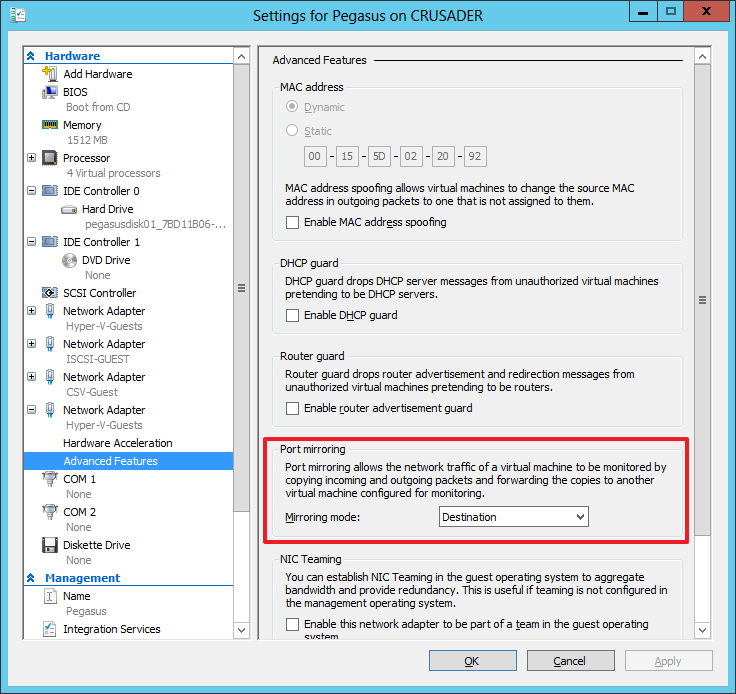
On the guest VM Pegasus, where we’ll capture the network traffic via a dedicated vNIC (“Sniffie”), we set that vNIC (virtual port) to “Destination” as Mirroring node:image

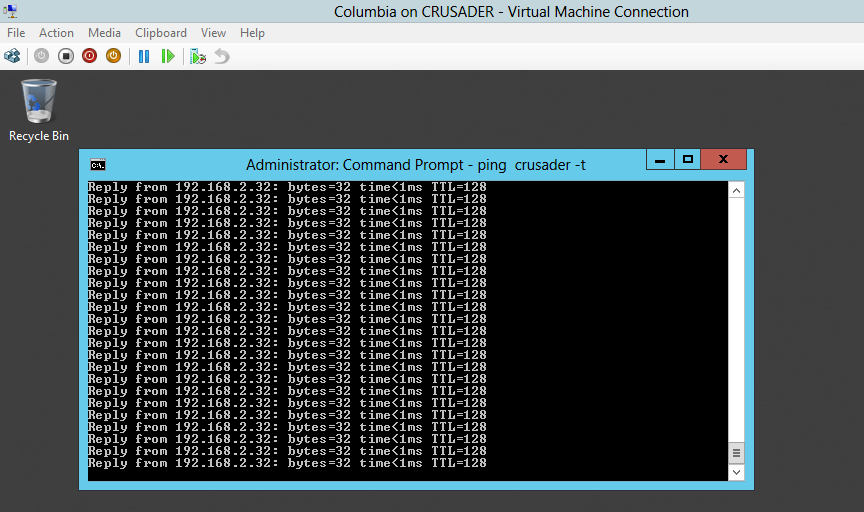
So now let’s start pinging a host (ping –t crusader)  on our Source VM  Columbiaimage

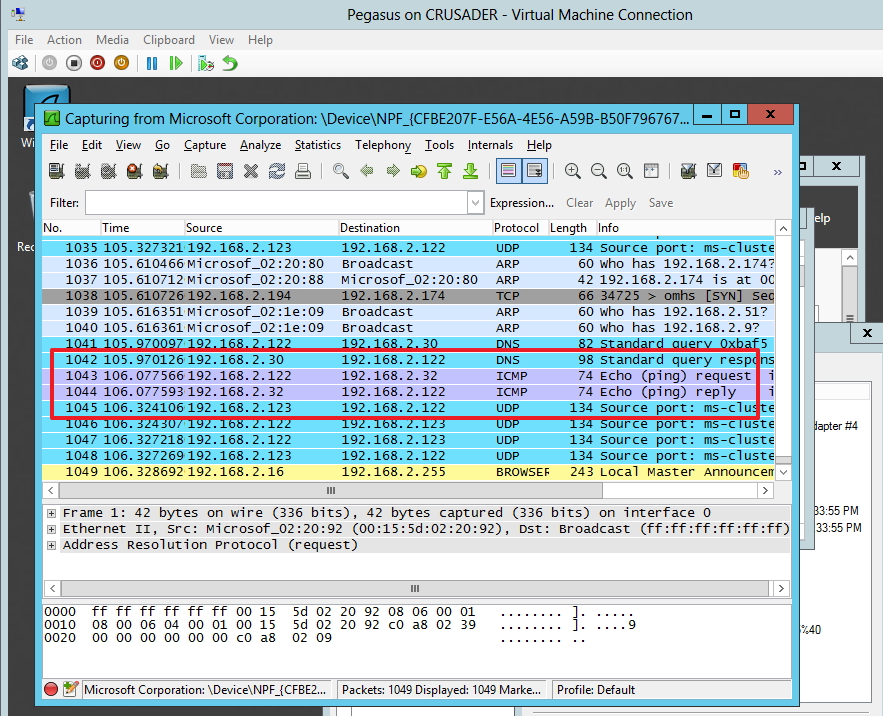
And take a look on the Destination vNIC on virtual machine Pegasus where we’re capturing the traffic. The “Sniffie” NIC there is set to destination as Mirror Mode. Look at the ICMP echo reply from form 192.168.2.32 (Crusader host). Columbia is at 192.168.2.122 sending out the ICMP echo request.image

Pretty cool!

Some Technicalities

So deep down under the hood, it’s the switch extension capabilities  of the Hyper-V virtual switch that are being leveraged to achieve port sniffing. This is just one of the many functionalities that the Hyper-V extensible switch enables. The Hyper-V extensible switch itself uses port ACLs to set a rule that forwards traffic from one  virtual port to another virtual port. For practical reasons translate virtual port to vNIC in a VM and this translates into what we shown above. While it’s good to know that port ACLs are what is used by the extensible switch to do enable all kinds of advances features like port mirroring but you don’t need to worry about the details to use it.

Things to note

Initially many of us made the assumption that we’d be able to sniff the traffic form a virtual port to a port on their physical switch. This is not the case. Basically, in box, it’s a source VM that mirrors it’s network traffic form one or more virtual ports (vNICs) to a destination VM’s one or more virtual ports (vNIC).

You can send many sources to one destination. That’s fine. You could also define more destinations on the same host but that’s not really wise and practical as far as I can see. All in all, you set it up on  when needed on the source VM and you keep a destination VM with a sniffer around for the sniffing.

Also keep in mind that all this works within the boundaries of the same host. Which means that if you want to monitor a VMs network traffic when it moves across nodes in a cluster you’ll have to have "destination” virtual machine on each host. This means that when a source VM is live migrated it will mirror the traffic to that local destination VM. That works.

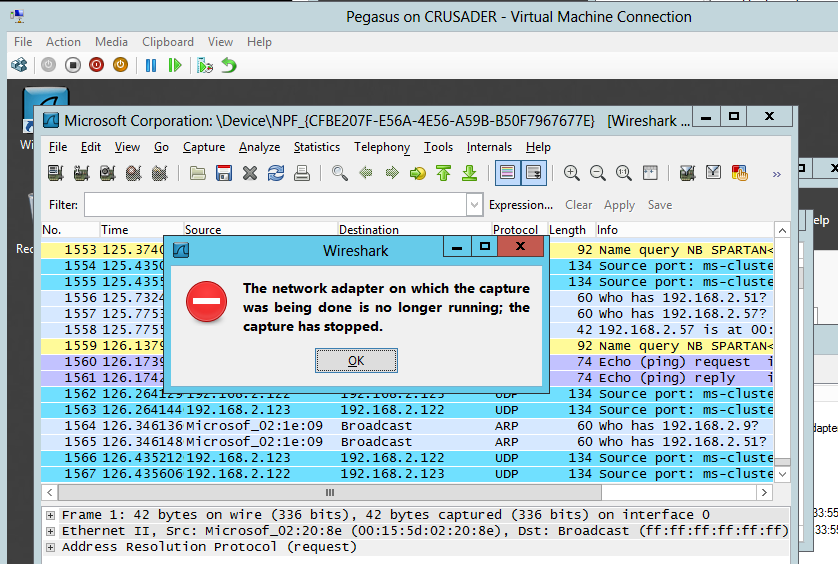
You could try and live migrate source & destination VMs to the same host but this is not feasible in real life. For one the capture doesn’t survive after a life migration as your sniffer loses connectivity to virtual Port / vNIC.image

Don’t be too disappointed about this. Port mirroring is not meant to be a permanent situation that you need to keep highly available anyway, bar some special environments/needs.

Whilst is it true that out of the box you can’t do stuff like sending the mirrored traffic form a guests vNIC/virtual port to a physical switch port where you attach your network sniffer laptop or so. If you throw on the CISCO Nexus 1000V it replaces the Microsoft in box “Forwarding Extensions” and than it’s up to CISCO’s implementation to determine what you can or can’t do. As this stuff is right up their sleeve they allow the Cisco Nexus 1000V mirrors traffic sent between virtual machines by sending ERSPAN to an external Cisco Catalyst switch. I have not had the pleasure of playing working with this.

Anyway, I hope this help to explain things a little. Happy sniffing and don’t get yourself into trouble, follow the rules.

Attending The Converged Infrastructure Think Tank At Dell Technology Camp 2013

I’m travelling to Amsterdam tomorrow to contribute in a “Think Thank on Converged Infrastructure” during the Dell Technology Camp 2013. The topic of this technology camp is the Evolution of the Data Center, hence the think tank on the converged infrastructure.

image

If you have any views on this subject, questions, or perhaps even “angsts” share them via twitter and we’ll see if we can discuss these. Don’t be shy! I’m pretty much a practical guys and for me any technology, no matter how much fun I have with them, is a means to an end. That means I think that a converged infrastructure can work for both the SMB/SME & large Enterprises if you do it right and at a good & affordable price level. Right sizing without getting stuck in that size, whilst not overpaying for future proofing is important. Long term in IT is a crap shoot Smile.

The biggest risks here is that the vendors don’t get what doing it right means & what is affordable. From the Microsoft community we’ve been discussing concepts like a Cluster in Box as a building block and other features that Windows Server 2012 enables for us. So far we’ve seen very low interest from the big vendors. From SMB to SME, we sometimes feel that OEMs look more at each other than at their customers needs and pursue agendas that fit only the bigger environments & pockets. Some partners look way to hard at their bottom line to be considered trusted advisors; They’ve lost the “VA” in Value Added Reseller. Serve your customers needs and you’ll have a business. Ignore us and you’ won’t ever have to deal with or worry about us again Winking smile.

On the other side I see the bigger players struggle with processes, methodologies and separation of roles that only hinder progress and prevent agile and dynamic IT.

We’ll see what the other attendees have to say, as I’m very interested in that. Looking at what other industries & roles think and do – and why – can be very educational. Vendors & Partners have a very different view on the matters than end customers have and the good ones know how to match both worlds to everyone’s benefit & satisfaction.

Follow the action on twitter via  #DellTechCamp, via live streams on http://www.fittotweet.com/events/techcamplive/ or https://www.etouches.com/ehome/index.php?eventid=53104&.