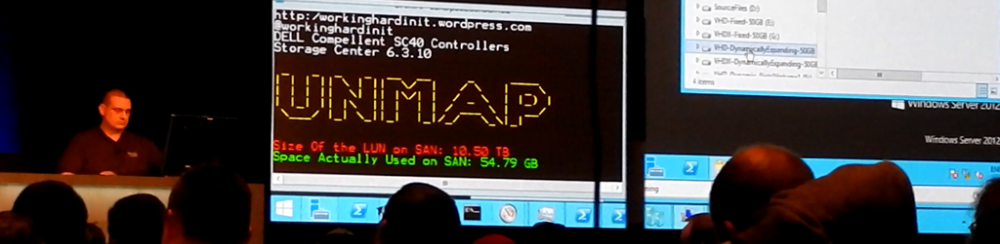
Why I Find Value In A Conference

For those of you who are attending a high quality conference I’m going to share some tips. It’s great to be able to attend a conference. Not because it’s in a great city and you’ll get to dine out at night, but because of the opportunities it provides us to learn and grow.

So what is the value of such a conference? Well, it is about the communication with peers and guru’s. The conversations you’ll have and the exchange of taught and ideas. The technical information you’ll gather, the products and techniques you’ll see. All of this will help you to direct and focus the way in which you approach your job, run your projects, plan and realize your visions and ideas. A conference, if done well, is nothing more or less than a technical education in the business of ICT and how to do things and make it work, results versus efforts wise. On top of that you get to interact and share ideas with your peers. You can’t ask for anything more.

Conferences cost a lot of money, time and energy. After all when you’re attending you have no income or the boss pays you while you’re not in the office creating value. On top of that you have to pay for the hotel, flight, daily expenses and the conference fee.  So why would we do this? There’s a global crisis, there’s a European crisis, there’s an XYZ crisis and there is economic doom and gloom all over the place. Not to mention all the results of that downturn … cutbacks, redundancy, foreclosures, failing businesses, unemployment, etc. The conference scene is not immune to a recession. Conferences are canceled, scaled down, attendance drops.  The competition from blogs, on line, free or subscription based content, pre views, beta’s, web casts, computer based training can be felt as well, as has been the case for many years. Conferences need to fight to maintain high standards of technical content for an ever more demanding and skilled public in a very rapidly changing world and IT scene. But still, a conference done right is an investment worth making. It is an investment in knowledge. In return we get all of the above mentioned in the previous paragraph and that is why I attend them. They make me a better “Technical Architect”. That is try I really put in the effort to get the funds, create the opportunity and reserve the time to go. The benefits of a conference, if done right, cannot be denied.

What is the right way?  Well first here’s the wrong way. Don’t go there or learn how to use delegates in .NET or to build a Linq to Wmi query. It’s not just an ordinary classroom. Do not go there to nag about some issues you had or have because you’re too lazy to do research and read help files, readme texts, TechNet or MSDN. Do not go to complain about how hard it is to find information and study.  Do not go because of the great location, you will see nothing of it 🙂 unless you use it as a vacation. Maybe some USA people deserve to do this but heck I’m from Europe and I get my fair share of holidays. Also, take any frustration, denial or ignorance about the lies of instant gratification and careers success you might have had when you bought product X and it didn’t just improve your live after clicking “Next” somewhere else. Results and successes come from an enduring effort, which is a fancy word for hard work. They are not a right, a perk or let alone guaranteed (yeah some vendors and people lied to you, get over it). If you cannot search study and learn on your own get out of ICT now. If you need support for every issue or new item and expect someone to be there to help every step of the way you’re in trouble. It takes time, dedication and a great deal of effort to become and stay proficient in IT. Even then you’ll know about failure, setbacks, troubles and mistakes. Life & work is not a commercial.

Go to a conference for the big picture, the architecture, the networking with peers, the possibilities and the dreams. Expand your knowledge and views on how to make the pieces work and interact. The focus of the conference is on tying it all together, learning new and better ways, discovering possibilities which all equals to yet more stuff to learn and more work to do. At the booths manned by industry experts or representatives do give feedback about the product and offer to send some more details about certain real problems you might have come across. But be nice and polite, don’t be a jerk. Would you feel compelled to help a jerk? Techies are people, really!

Don’t run to sessions like a mad man without a plan.  Know why you are there and how to get what you’re after. If this is your first conference, everything will be new and fabulous (I hope). You can’t attend enough sessions. You are torn between the choice of sessions and tracks. You’re full of new ideas immediately and overwhelmed with even more just after that. So for all you newbie’s, get your act together and prepare a bit or it will turn into chaos. Write down ideas, insights and possibilities to pursue. What about you conference veterans? Have you’ve been there, done that?  Have you have seen it all before? Not really, and we all know it.  It’s all about lifelong learning. Conferences are about being in a stimulating environment where you “marinate” in the professional IT community for a week. Learn from and with the people attending. Not only during sessions. Lunch with them, have a coffee with them. Immerse yourself in this explosion of IT and business. Think about the new stuff, use your imagination, and write down ideas. Cross check your plans. Calibrate you insights.

The role of the conference is get you thinking about stuff and gives you a chance to talk to each other about that stuff. Interact! It is the essence of a conference. Ask questions both in public and in private. Talk to attendees, to experts, to vendors. See what they are in to, need, tried, where they succeeded and failed. Find out what they have to offer. Talk shop, talk IT life, and make that connection with the others attending in whatever role. There is a wide world out there much bigger, larger and perhaps tougher than your own little world that is driven by results and built on efforts. Those folks have professional and business experience in all of the subjects being discussed. Pick their brains! Get some new insights and ideas. Yes I know some vendors act like 2nd hand car dealers and yes I’ve met people who don’t know their own products. But that doesn’t rule out the need for and benefits of communication and interaction, those where just the wrong people, just move along. Oh and don’t forget to get a bunch of extra business cards you got out of the drawer. Also keep in touch with people you meet. Send a follow up mail, a tweet, a blog mention. That’s how you expand your knowledge network. If you get to go to a conference, enjoy it and make sure you arrive early and leave late. There is no value in missing a part of the experience to save some time or some €/$ bills.

I don’t implement all the ideas I return home with from conferences. But I have them written down in mails, scraps of paper, txt files, One Note scribbles etc. I tend to pour them into a word document during and after the conference. Form that I distill my plans, my vision and my roadmap.  I will present those to management, colleagues, partners and customers and offer them solutions based on my perception of what business needs we can satisfy with technology. The stuff I’m working on now was born as ideas 12 to 18 months ago. Those ideas are tested and checked over time, they ripe and then they become plans. I find a conference a great place to do that.

Tech Ed 2010 Europe – Just registered

As a heads up people, I’m attending Tech Ed 2010 Europe from November 8th to November 12th in Berlin, Germany. Join me and thousands of hard core IT Professionals in learning, exchanging ideas, networking and preparing to design, plan and shape the future of ICT in the Microsoft space.

I’m looking forward to some 300/400 Level sessions on OCS14, System Center vNext, Exchange 2010 SP1, Windows 2008 R2 SP1, … etc. It’s always great an fun to meet up with old and new people from the IT community on line and off line. Engage in discussions with colleagues and Microsoft Employees, go out for dinner with fellow IT Pro’s & Devs.

Looking forward to it. Tech Ed is what you make of it. I might blog about that later. It takes some work & preparation to get the most out of it. Hope to see you there!

If you read my blog, follow me on twitter or know me and you’re going, sound of and we’ll arrange a meet & greet.

Exchange 2007-2010 Public Folders Issues “The Active Directory user wasn’t found.”

I was working on an Exchange 2007 to Exchange 2010 project when we ran into trouble creating our first public folder database on an Exchange 2010 server. Mind you, this was just creating the database. We did not even set up replication for this database yet. All mailboxes still resided in Exchange 2007 databases pointing to an Exchange 2007 public folder. Very soon after creating the database we got notified users could no longer send mails to mail enabled public folders. The exact error was this:

554 5.6.0 STOREDRV.Deliver.Exception:ObjectNotFoundException; Failed to process message due to a permanent exception with message The Active Directory user wasn’t found.

Also browsing of the public folders in Outlook was slow and the application froze/hung. These issues where fixed very fast by getting rid of the still unused public folder database all together. Now we could commence our search for the root cause. The error seemed related to the issue described in Public Folder Replication Fails Due To Empty Legacy Administrative Group which can be found @ http://msexchangeteam.com/archive/2010/05/05/454821.aspx  The blog describes this error during replication:

Log Name: Application

Source: MSExchange Store Driver

Event ID: 1020

Level: Error

Description:

The store driver couldn’t deliver the public folder replication message “Hierarchy ([email protected])” because the following error occurred: The Active Directory user wasn’t found.

But apart from replication not working there were other, more severe issues impacting end users who can still all be on Exchange 2007. The hanging of the outlook clients and mail enabled folders no longer being available. Dave Stork blogged about this in http://blogs.dirteam.com/blogs/davestork/archive/2010/03/16/mail-enabled-public-folder-recipient-not-found.aspx

Now the first mentions of the replication issue have been reported back in November 2009 (see http://get-exchange.blogspot.com/2009/11/public-folder-mayhem-exchange-2010.html) but still hasn’t been fixed. For the moment that fix is planned to be included in E2K10 RU5. Currently we’re at RU3, so that might well be august 2010.

The workaround described in above mentioned blog posts works & is effective immediately. Now they described the issue and the fix very well but I’ll add to tips.

Tip 1

“Practical End User Friendly Detection” of this issue can be done using exfolders.exe. You can read more about this tool here: “Exchange, meet ExFolders” (http://msexchangeteam.com/archive/2009/12/04/453399.aspx).The error only occurs when you create a public folder on Exchange 2010 and can be very annoying for the users so I’ll share this tip with you. Download the tool here http://msexchangeteam.com/files/12/attachments/entry453398.aspx and install it on an Exchange 2010 server in the bin directory (follow the readme.txt and don’t forget to merge the .reg file or the tool will crash). Running exfolders.exe and connect against any Exchange 2007 public folder. When you get this error …

—————————

ExFolders

—————————

An error occurred while trying to establish a connection to the Exchange server. Exception: The Active Directory user wasn’t found.

—————————

OK  

—————————

… you know you are affected. Deleting the empty Servers containers from ALL legacy Administrative Groups fixes the error. You then can connect successfully to a Exchange 2007 public folder with exfolder.exe. Which is a cool way to test for this issue and if the fix works as you don’t need to create a public folder and possibly hinder you users.

Tip 2

Also note that you need to delete  (using ADSIEDIT) every empty servers container out of every legacy Administrative Group, not just or only the one in the “First Administrative Group”. Don’t worry if you renamed that one to something more descriptive, that doesn’t matter at all. All the servers containers in the legacy Administrative Group should be empty I you have no more E2K3 servers left in your exchange organization. Feel free to leave comments on your experiences.

Partially Native USB support coming to W2K8R2 with SP1!?

As you might recall from a previous blog post of mine (https://blog.workinghardinit.work/2010/03/29/perversions-of-it-license-dongles/) one of the show stoppers for virtualization can be USB dongles. Apart from my aversion of USB license dongles that should never be mentioned in the same sentence with reliability and predictability, now the push for VDI has exposed another weakness, the need for end users to have USB access. Well Microsoft seems to have heard us. Take a look @ this blog post: http://blogs.technet.com/virtualization/archive/2010/04/25/Microsoft-RemoteFX_3A00_-Closing-the-User-Experience-Gap.aspx

What remains to be seen is if this will work with license dongles. Anyway for desktop virtualization a much needed improvement is under way. I would like to thank Christophe Van Mollekot from Microsoft Belgium for bringing this to my attention. This together with VDI license improvements for SLA customers are giving desktop virtualization a much better change of being adopted. Some times stuff like this really makes the difference. You can’t explain to your end users that the great super modern virtualized environment doesn’t support the ubiquitous USB drive. Trust me on that one.