E2EVC 2016 Dublin

So after 4 days in London with the Veeam Vanguards I’m hopping over the Irish sea tonight towards Dublin to attend and present at the Experts 2 Experts Virtualization Conference (E2EVC) 2016  Dublin.

image

I’ll be presenting on High Availability with Windows Server 2016 Failover Clustering and Hyper-V. These are supported and enhanced by other new or improved capabilities in Windows Server 2016. So there will be a lot to take in. I’ll be around to talk shop before and after the session so if you want to chat, find me around the conference.

E2EVC a boutique community driven conference. It’s small scale and independence makes it a very direct experience in both realism and hard core real world experience in the virtualization ecosystem and related technologies. We encourage anyone to attend and present. No “prima donnas”  – you can speak when you want to as long as you’re willing to do so and share knowledge and insights.  Give it a shot!  I hope to see you there

SOFS / SMB 3 Offers Best VM Resiliency Experience

I have blogged about Virtual Machine Resiliency in Windows 2016 Failover Clustering before in Testing Virtual Machine Compute Resiliency in Windows Server 2016 

Those test and demos were done with block lever storage, CSV on Fibre Channel, iSCSI or shared SAS. Today we’ll look at the experience when you’re running your VMs on a continually available file share on a Scale Out File Server (SOFS). This configuration offers the best possible experience.

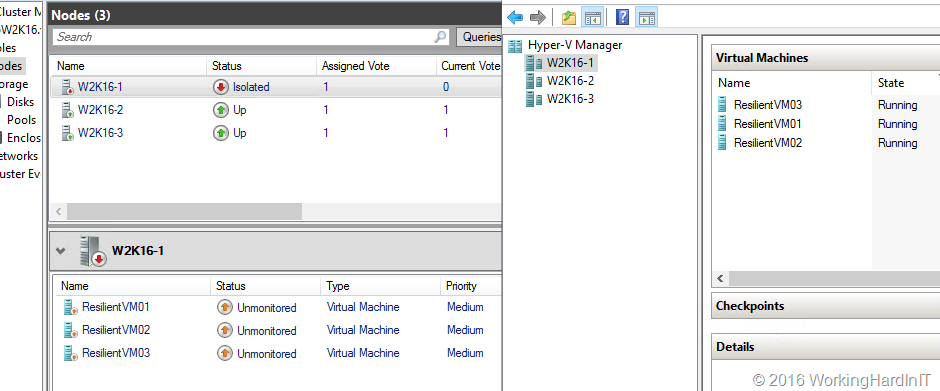
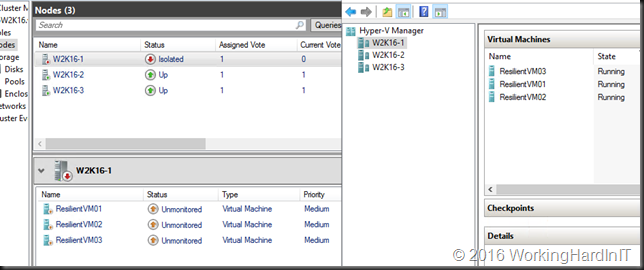
Why well, when the cluster node is in Isolated mode this has no impact on the SOFS share as this is a resource external to the Hyper-V cluster. In other words it remains on line. This means that the VMs, even if they have lost their high availability during the time the node is Isolated, they keep running. After all there is nothing wrong with Hyper-V itself. With block level CSV storage you lose access to the storage as that a cluster resource and the node got isolated. That’s why the VMs go into a paused critical state during a transient failure with block level storage but they don’t when you’re using SOFS.
image

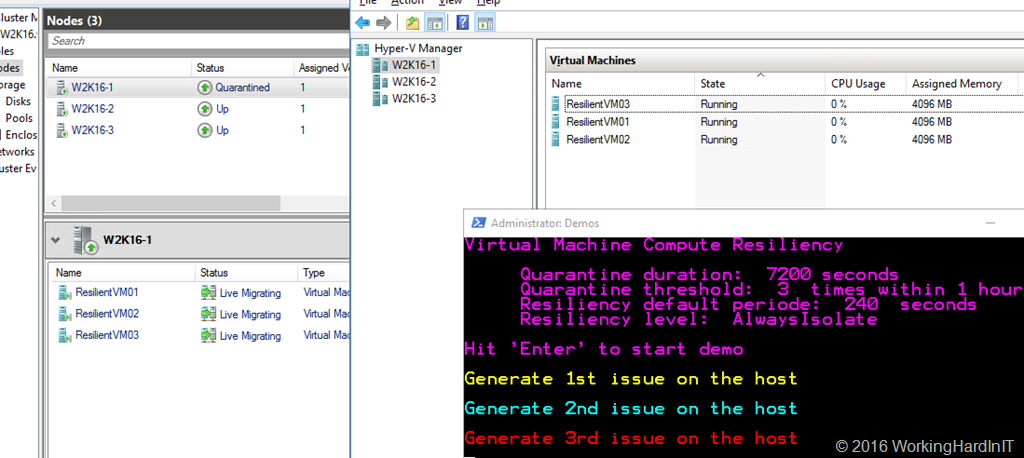
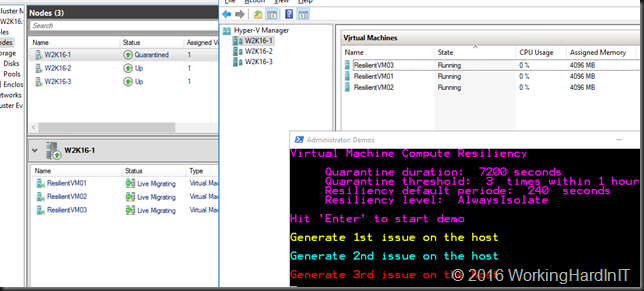
The virtual machine compute resiliency feature in action shows you that the VMs service a transient failure without issues. Your services need never know something was up. Even when the transient failure is reoccurring that doesn’t mean it will cause down time. The node will be quarantined and if it come backup the workload will be live migrated away.
image

You can watch a video of this in action here on Vimeo:
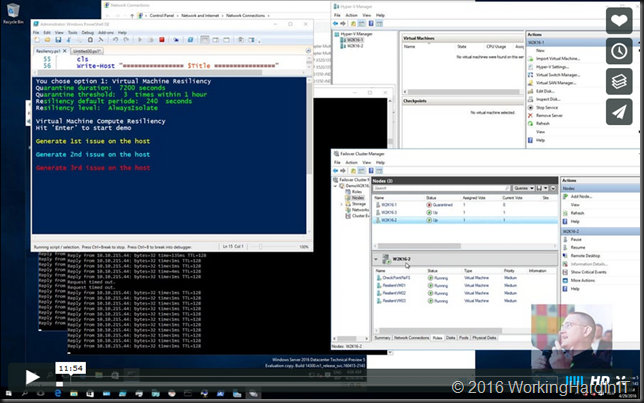
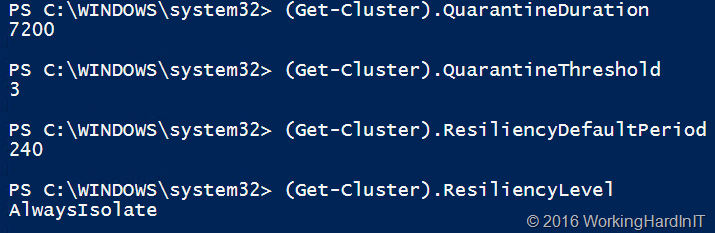
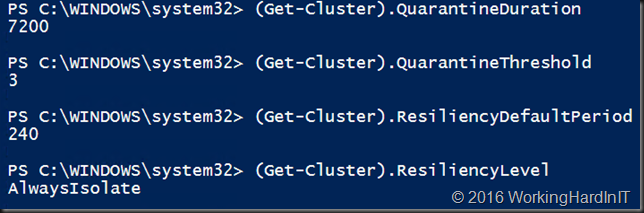
The quarantine threshold and duration as well as the resiliency period and can be tweaked to your environment to get the best possible results.
image

SMB 3 for the win! This is yet one more convincing argument to start looking into SOFS and leveraging the capabilities of SMB3. Remember that you can run as SOFS cluster against your existing shared storage to get started if you can get the IOPS/latency you require. But also look into storage spaces, especially storage spaces direct which avoids some of the drawback SANs have in such a scenario. High time for storage vendors to really scale out, implement SMB 3 well and complete and keep the great added value features they already have in their offering. It’s this or becoming yet a bit more irrelevant in todays storage scene in the Microsoft ecosystem.


Simplified SMB Multichannel and Multi-NIC Cluster Networks

Simplified SMB Multichannel and Multi-NIC Cluster Networks

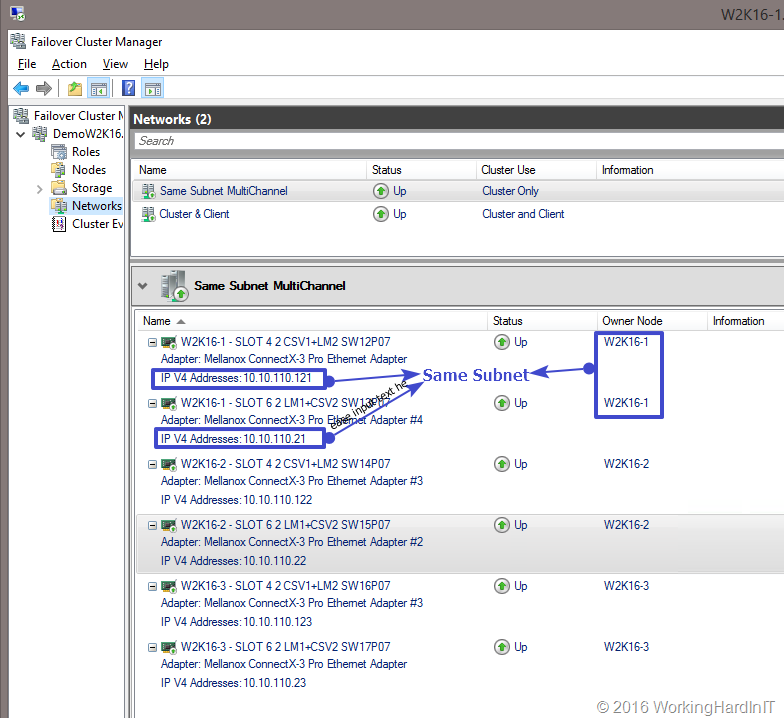
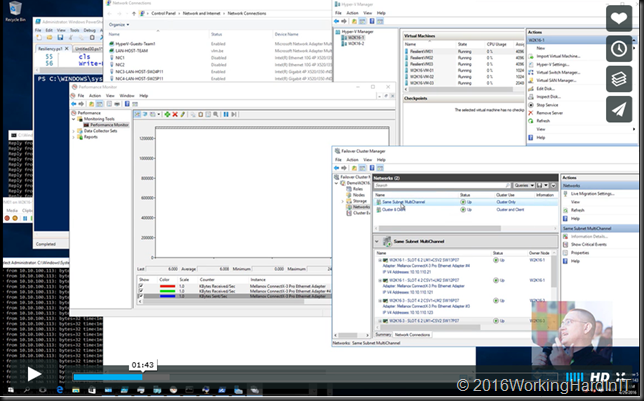
One of the seemingly small feature enhancements in Windows Server 2016 Failover clustering is simplified SMB multichannel and multi-NIC cluster networks. In Windows 2016 failover clustering now recognizes and uses multiple NICs on the same subnet for cluster networking (Cluster & client access).

image

Why was this introduced?

The growth in the capabilities of the hardware ( Compute, memory, storage & networking) meant that failover clustering had to leverage this capability more easily and for more use cases than before. Talking about SMB, that now also is used for not “only” CSV and live migration but also for Storage Spaces Direct and Storage Replica.

  • It gives us better utilization of the network capabilities and throughput with Storage Spaces Direct, CSV, SQL, Storage Replica etc.
  • Failover clustering now works with multichannel as any other workload without the extra requirement of needing multiple subnets. This is more important that it seems to me at first. But in many environment getting another VLAN and/or extra subnet is a hurdle. Well that hurdle has gone.
  • For IPv6 Link local Subnets it just works, these are auto configured as cluster only networks.
  • The cluster Validation wizard won’t nag about it anymore and knows it’s a valid failover cluster configuration

See it in action!

You can find a quick demo of simplified SMB multichannel and multi-NIC cluster networks on my Vimeo channel here

image

In this video I demo 2 features. One is new and that is virtual machine compute resiliency. The other is an improved feature, simplified SMB multichannel and multi NIC cluster networks. The Multichannel demo is the first part of the video. Yes, it’s with RDMA RoCEv2, you know I just have to do SMB Direct when I can!

You can read more about simplified SMB multichannel and multi-NIC cluster networks on TechNet in here. Happy Reading!

Get-VMHostSupportedVersion

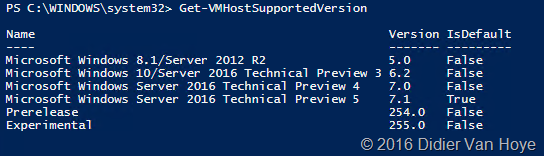
I wrote about this little Gem of a PowerShell Commandlet  Get-VMHostSupportedVersion before in here (there a bit more info on the impact of a VM configuration version in that blog). Now at TPv5 I took a new peak and what do we find?

image

We now have version virtual machine configuration version 7.1 at TPv5. We also got 2 new version ID’s 254.0 for Prerelease and 255.0 for Experimental. Clearly Microsoft has plans here.  I’ll update this blog with a link to the documentation when I find it.

All bets are open as to where we’ll land at RTM for the virtual machine configuration version. I’m guessing that we’re feature complete at Technical Preview 5 but version numbers can get funky. Will all TP version be supported at RTM? Normally upgrades from beta / preview versions are not supported but on the other hand some people in early adopter programs are working on it already so I’m guessing they will. We’ll see, but that’s where I put my money.